Showing posts with label Detroit. Show all posts

Friday, May 7, 2021

A Man of Tried Courage, Patriotism, and Fidelity: Major Thomas Maxwell and the War of 1812

 On July 7, 1818 Colonel Joseph L Smith, commanding officer of the 3rd Infantry Regiment and of Detroit, wrote to Daniel Parker, the Adjutant and Inspector General of the Army at Washington, D.C., regarding an aged man who was setting off on a journey back east: “Sir, Major Thompson Maxwell who has been on duty at this place for the last two or three years in the capacity of principle barrack master is about to visit- walking, too…” The man he spoke of claimed to have been a survivor of at least four wars: the French and Indian War (1754-1763), Pontiac’s Rebellion (1763-1766), the American Revolution (1775-1783), and the War of 1812 (1812-1815). He had fought as one of Roger’s Rangers; had been one of the disguised Sons of Liberty who participated in the Boston Tea Party; had been a captain in the Massachusetts militia during Shay’s Rebellion in 1787.

            Whether Maxwell was present at all these events is not undisputed by historians. One recent web article calls him “the Forrest Gump of the American Revolution” (https://www.newenglandhistoricalsociety.com/thompson-maxwell-the-forrest-gump-of-the-american-revolution/ accessed 5/5/2021). However, what is easier to verify is his service during the War of 1812, which is verified by both primary and secondary sources. Most of the latter remark on his presence with William Hull’s army when it marched to Detroit. However, in the aftermath of Hull’s surrender of Detroit, a local mob singled out Thomas Maxwell for reprisal and burned his house down. Homeless and destitute, in his 60s, Maxwell remained with the American army throughout the rest of the war.

            In 1800, Maxwell and his family had moved to Ohio and settled in Butler County, north of Cincinnati. Maxwell made a living, apparently, by driving hogs overland to Detroit, and from this and his service during the French and Indian War and Pontiac’s War—during which he had been to Detroit and Mackinac, he had a good knowledge of the wilderness between the Ohio settlements and the Michigan Territory. During Hull’s campaign he made a lifelong friendship with Lt. Colonel James Miller of the 4th Infantry Regiment. When Colonel Miller led an American force south from Detroit to try and break open the supply lines to Frenchtown, Thompson Maxwell volunteered to serve as chief scout, and went on horseback ahead of the column. A few days before, another American column had been ambushed and several scouts had been killed and mutilated. Maxwell himself claimed to have survived the infamous Battle of Bloody Run in July 1763 which had occurred only a few miles away outside Detroit. This time, there was another, stronger ambush which would be called the Battle of Maguagon, but Maxwell survived, and the Americans counter-attacked and won the day.

            However, in the wake of William Hull’s surrender of Detroit, Thompson Maxwell had to give up his horse, bridle and saddle to the enemy. He was paroled with most of the other Ohio volunteers and dropped off in Cleveland to make his way home as best as he could. His homecoming was a sour one. Another Ohio officer, a Captain Robertson who had been accused of cowardice during a skirmish near the Au Canard River during the campaign apparently sought to deflect his role in the defeat and got together a mob to attack him. Maxwell and his family escaped the mob, but they burned his house and most of his possessions. The Major’s reputation with the senior officers of the army was such that he was able to get letters of introduction from Colonels Lewis Cass, James Finley, Duncan McArthur, Major Thomas Van Horne, and Colonel Miller recommending him to Major General William Henry Harrison for service: “We can safely recommend him to any employment which requires firmness and perseverance.” (Harrison Papers).

            Major Maxwell had an aura of experience which awed younger officers. Lieutenant Joseph H Larwill encountered him on February 1, 1813 at the Northwestern Army’s camp on the Portage River: “He was one of those who was taken at Fort Edward, fought at Detroit and Bloody Knife when attacked by the noted Indian Pontiac, was through the most difficult scenes of the Revolutionary War and distinguished himself at Brownstown and in Hull’s Campaign. He is too feeble to stand the fatigues of a march but his breast burns with love of country and is desirous of rendering all the service that lies in his power, cares not the situation he may be placed in.”

            Maxwell served on General Harrison’s staff as a civilian guide through the early months of 1813 and was present during the construction of Fort Meigs. However, after the Battle of Frenchtown in January 1813, during which some local militiamen who had been involved in Hull’s campaign were captured again, there was fear that volunteers who might be captured again before being officially exchanged would be sent to Quebec and hung for breaking their parole. This apparently nearly happened to another scout named Whitmore Knaggs, who was captured a second time by Indians but let go. Maxwell returned to Butler County on February 25, 1813 only to find that his second wife had died 20 days beforehand.

Maxwell stayed with his son, until three days later when an anonymous note appeared at the house: “if you secret Maxwell another night, your home will share the same fate with his.”  After that, Thompson Maxwell stayed with other friends, travelled to Cincinnati, and was hosted for a while by Duncan McArthur in Chillicothe before trekking back to Cleveland where the commanding officer was another friend from Hull’s army: Major Thomas Jesup. From Cleveland Maxwell rejoined the American Army at Fort George, and remained with it as a volunteer throughout 1813 and 1814.

By 1814 both Major Thomas Jesup and Colonel James Miller had assumed command of regiments in the Left Division commanded by Major General Jacob Brown (Jesup commanded the famous 25th Infantry in Winfield Scott’s Brigade, and Miller commanded the 21st Infantry in Eleazar Ripley’s Brigade.) Major Maxwell seems to have served alongside them as a forage master until the siege of Fort Erie, when he was captured somewhere in Upper Canada outside the American perimeter of the fort. There is another element of serendipity here too, since the dragoons who captured him were led by Major Peter L. Chambers of the 41st Regiment of Foot. Chambers might have recognized Maxwell from the surrender of Detroit, and had served with the British forces in the Northwest before being captured himself at the Battle of the Thames in 1813.

Thompson Maxwell again lost his horse, his hat and spurs, and was left with nothing but a handkerchief to wear on his head as he was marched into captivity. The prisoners were made to walk 60 miles to Kingston. On a stop at Hamilton, they were forced to stay in a small room, “the stench was so bad and I feeble, that I came back to the door and leaned against the side of it.” The captain of the guard ordered him to go back in, despite Maxwell’s protest that he was sick. In response, the officer ordered the sentry to force him back into the room with the point of a bayonet. “At this moment Major Rogers (the commissary of prisoners) came along and asked what was the matter.” When Maxwell told him his name, Rogers recognized him as a man his father had mentioned having served with during the French and Indian War:

“Major R. gave the Captain d----, and said to me “Come along with me!” He was put up in a house, given a clean shirt and a blanket coat, and sent to Kingston on a horse. In Kingston he was well treated, but in late October he was transferred to Montreal in an open boat, and was placed under close confinement until March 1815. Several months after the war ended, he was returned to the territory of the United States at Sackett’s Harbor, New York. There he met General Jacob Brown, who had commanded the army at Fort Erie. General Brown gave him $60 and sent him on to Buffalo, where he was able to collect $375 in back pay.

After the War of 1812, Maxwell secured a position as Barracks Master at the US Army post at Detroit. In 1818, when Colonel Smith wrote his letter to the Adjutant General, Maxwell made his way (riding, not walking) overland from Detroit to New Hampshire, where he visited his old friend General Miller, who would be appointed to serve as the first governor of the Arkansas Territory. While staying with Miller, Major Maxwell dictated his life story, which was transcribed by the General's secretary Lt. Allanson. This unpublished memoir, with parts such as the Battle of Maguagon left out "to be filled in later" by Miller, who had also been present. As a result there are many gaps in the narrative concerning Maxwell's part in the 1812 and 1814 campaigns. Returning to Michigan, after his retirement Maxwell lived in a cottage outside town, and passed away aged 90. He is buried in the Wallaceville Cemetery, in Dearborn Heights, Michigan.

Sources:

“The Narrative of Major Thompson Maxwell,” Historical Collections of the Essex Institute 7 no. 3 (June 1865).

Letter of Colonel Joseph L. Smith to General Daniel Parker, 7 July 1818 (National Archives: Letters Received by the Adjutant General)

James L. Barton, Address on the Early Reminiscences of Western New York and the Lake Country… Buffalo: Steam Press of Jewett, Thomas & Co., 1848.

Find A Grave: Thompson Maxwell

(https://www.findagrave.com/memorial/16280641/thompson-maxwell accessed 5/7/2021

            New England Historical Society “Major Thompson Maxwell, Forrest Gump of the American Revolution" (https://www.newenglandhistoricalsociety.com/thompson-maxwell-the-forrest-gump-of-the-american-revolution/ accessed 5/7/2021)

Sunday, April 26, 2020

The Bizarre Afterlife (s) of HMS Detroit

The modern sailing training ship Oliver Hazard Perry, formerly the reconstructed Detroit.

The ship sloop Detroit was the most powerful ship on the Upper Great Lakes when she was launched at the Amherstburg Naval Dockyard in July of 1813, and fitted out on the Detroit river in August. However, from the beginning she had a jinxed life. Built to counter the Americans new 18-gun brigs then being built at Erie, Pennsylvania, she was to mount 20 24-pounder carronades and 4 12-pounder long guns. Because Amherstburg was on the end of a long string of British outposts, some of which were attacked and captured while the Detroit was under construction, getting the vessel fitted out and armed was a major struggle. After her carronades were captured when the capital of Upper Canada, York (modern day Toronto) fell to an American attack, the British had to scrape together a mixed armament of 24-pounders and 12-pounders and other odd long guns, including an 18-pounder on a pivot mount. This still made her a formidable ship but she was captured along with the rest of the British squadron--not before being nearly shot to pieces and losing most of her crew and officers. The damage was so severe that although she was taken into American service as the USS Detroit, the vessel spent the winter of 1813 at Put-in-Bay before being repaired enough, along with her sister Queen Charlotte, to limp back to Erie, Pennsylvania. At the end of the War of 1812 both ships were sunk along with the American brigs to preserve the hulls. If another war with England came, they could be raised and fitted out again.

The Navy sold the submerged hulks off, and in 1836 an Erie merchant raised the Detroit to use as a merchant ship. She again sailed the lakes until 1841, when according to most sources she was bought by a group of Niagara area merchants who planned to send her over the Niagara Falls as a stunt. The vessel grounded somewhere in the rapids above the Falls, and broke up. Probably, there are fittings and timbers scattered through the rapids in the area that belong to the ill-fated Detroit. Ironically, the first HMS Detroit, the US Army Brig Adams captured from the Americans in 1812, then recaptured by Jesse Elliot, ran aground and burned in the Niagara, a few miles upriver of her namesake.

That's not the end of the story, however. In 1998 an Ontario group raised funds to build a steel-hulled replica of the Detroit to be based at Amherstburg, Ontario. They finished the hull, apparently, but after spending 3 million dollars, they had run out of money before they could fit it out and operate it. From 2003 to 2015 the project was stillborn, but at last a group of Rhode Islanders swept in and purchased the hull, had it towed to Oliver Hazard Perry's hometown of Newport, and fitted out as a sail training vessel. In an ironic twist, it was renamed the SSV Oliver Hazard Perry.


"The Ships of War are Coming In." -- To the immense number of vessels navigation Lake Erie, is about to be added a class rendered famous, in former days and the sight of which, engaged in commerce, will be calculated to awaken the patriotic feelings of every American beholder. The vessels composing a part of the glorious fleet of the victor Perry, with a number of the prizes taken from the enemy in the ever memorable battle of the 10th of Sept., 1813, which have since the close of the late war, sunk in this harbor, have lately become the property of Messrs. Miles and Leach of this place, are to be fitted up for Lake trade. The QUEEN CHARLOTTE, (a prize) was raised on Monday last. Her timbers were found to be perfectly sound. She is to be repaired and rigged for a brig this season. The LAWRENCE, (American) and the DETROIT (prize) are to be raised immediately -- the former intended to be converted to a steam boat. ---- Erie Observer 
      Cleveland Weekly Advertiser 
      Thursday, January 20, 1835; 3; 1. 
      PERRY'S FLEET. - Two more of the vessels engaged in the ever memorable action of the 10th. Sept. 1813----the LAWRENCE and the DETROIT---have been raised from their watery bed in this harbor, for the purpose of being brought again into action, not for the destruction of human life as formerly but to be used in the more peaceful and profitable pursuits of commerce. The timbers, like those of the QUEEN CHARLOTTE are found to be perfectly sound, and there is no doubt they will richly reward their present proprietors for their enterprise in bringing them once more to the surface of that water on which they were once so distinguished, and placing them again in a state for public usefulness. 
      The LAWRENCE, which was the flag ship of Commodore Perry, was raised during the firing of a national salute, on the 10th. inst. the anniversary of the action in which her commander was so successfully victorious, just twenty-two years before. - Erie Observer 
      Buffalo Daily Star 
      Thursday, September 17, 1835 
The ship DETROIT, flagship of the British squadron on Lake Erie in 1813, has arrived at Detroit. She was raised by the exertions of Capt. Miles from the basin at Erie, where she has lain sunk since 1814. Her timbers, decks, &c., are perfectly sound. About twenty 32 pound balls were taken from her timbers, during the repairs, and a great number of smaller, from twelves to grape shot. Some are yet remaining in her wales. She is 260 tons burthen, has a gentleman's cabin with 16 berths, ladies' cabin, 8 berths, steerage, 18 berths, and 3 state rooms, sufficient each to accommodate a family. 
      Cleveland Weekly Advertiser 
      Thursday, August 25, 1836 
The British Barge DETROIT - This vessel which was sunk during the last war at Erie, and raised by Capt. Miles, is now lying at the wharf in this city. Very little alteration has been made, her hull, cabins, &c., remain as they were. There is still to be seen on board of this vessel, an eighteen-pound ball, lodged in her starboard side, just under the deck and opposite the foremast, which attracts a good deal of attention. - Cleveland Adv. 
      Detroit Democratic Free Press 
      June 28, 1837 

The barque DETROIT, once a British vessel of war, is now in port. She belonged to the fleet captured by the brave Perry, and was sunk for preservation many years ago, at Presque Isle. She was raised last season and has been fitted up for the trade of the uper (sic) lakes. - Buf. Star. 
      Detroit Democratic Free Press July 13, 1837 

Wednesday, May 6, 2015

A Map of Operations on the Detroit Frontier: 1812

This map is from pg. 333 of the Canadian Magazine vol XX (November 1902-April 1903). It offers a reasonably clear view of the locations involved with William Hull's campaign.


Saturday, March 28, 2015

A Narrative of the Battle of Brownstown

It's been quite a while since I've posted, mostly for lack of activity on either my book project or reenacting over the winter. However, I'm keen to revamp the design of the blog and post some new and interesting content. Now that the War of 1812 Bicentennial is over, I feel more free to address whatever stories or topics from the period strike my fancy, as opposed to trying to commemorate certain events-- not that I ever felt constrained in that manner.

This is an interesting primary account of the skirmishes and battles which took place around Detroit in the summer of 1812, and which led up to the surrender of Detroit and the Michigan Territory by General William Hull. I'll post some of the highlights this coming week, but in the meantime check it out on Archive.org. And be sure to tell them what you think, good or bad, about their site redesign!

Wednesday, December 24, 2014

Daniel Dobbins and the Escape from Detroit, 1812.

A schooner like Dobbins' in the Battle of Lake Erie, 1813.


This is an excerpt from the chapter of the book I'm currently working on, which made me turn back the clock somewhat on my research in order to understand better the events going on in naval war on the Great Lakes in 1812-15. Sailing Master Daniel Dobbins doesn't get a lot of attention from historians and popular culture, but he was a true American hero, in the adventurous way that many heros were made 200 years ago:
On July 17, 1812 when the British and Indians launched their surprise attack on Fort Mackinac, Captain Dobbins and his schooner were tied up at the wharf on the island. News of the declaration of war, already a month old, had not reached the far-flung settlements. With the nearby British outpost of St. Joseph's having cut off communications with the island, though, the locals feared hostilities had already commenced. The townspeople sent a experienced local man in a boat over to the British side to find out. On his way there he ran into the British strike force, several hundred soldiers, volunteers and Indians led by Captain Charles Roberts of the 10th Royal Veterans Battalion, and wound up having to act as a guide for the enemy.
As the British surrounded the little hilltop stockade of Fort Mackinac, they sent word to the civilian population in the town below to assemble for their own protection. Not trusting the Indians and hoping to offer his services to the American forces at Detroit, Dobbins decided to try to escape. He cast off his lines and, becalmed, began to kedge the Salina out from the island. This laborious operation involved rowing a kedge anchor out several hundred yards from the ship, then hauling it in to move the vessel forward, and repeating. No sooner had Dobbin and his crew began inching towards freedom than they saw “the painted savages crawling along round the bank, to avoid the guns of the fort.”
With his crew ready to “cut and run with the vessel as soon as a breeze sprang up,” Dobbins waited anxiously for wind. It came, but so did the armed brig Caledonia, flying British colors. The enemy ship stood between the Salina and the open lake, and Dobbins had no choice but to strike his colors and surrender. Back at the fort, which by now had surrendered to Captain Roberts, the British commander tried to get Dobbins and his men to sign a pledge not to take up arms against British forces. As a civilian, though, under the terms of the surrender Dobbins was free to go. Not a man to be intimidated, he announced his intentions to join the American military as soon as he reached their lines.
The captain and a few civilian families who had refused to take the oath were ordered to leave on the Salina to be repatriated at the port of Cleveland. They set out in company with the schooner Mary, itself loaded with the paroled soldiers from the American garrison. A few days later, they were stopped by shots fired across their bows by the American batteries at Detroit. General Hull's army still occupied both sides of the Detroit River, and the two ships fell once again into American hands. Captain Dobbins offered his services on land as a guide, and accompanied Lt. Colonel James Miller's force at the Battle of Magaguan on August 9. He soon joined a Detroit volunteer militia company under Captain Solomon Sibley, and volunteered to help place a battery of heavy guns at the village of Spring Wells south of town, in an effort to prevent the British from crossing the river. General Hull refused, and whatever the result of this undertaking would have been for the campaign, he surrendered on August 16 to the British forces surrounding Detroit. The schooners Salina and Mary were once again captured, as well as Dobbins and the other citizens of Mackinac.
The British forces thought that Dobbins had broken a parole by taking up arms at Detroit, and he had to hide under the overturned hull of an old wreck on the waterfront to avoid Indians who were hoping to collect a reward by capturing or killing him. The Quartermaster General of the British forces, Lt. Colonel Robert Nichol of the 2nd Norfolk militia regiment, wrote out a pass guaranteeing Dobbins' safety, apparently because he was a brother Freemason. The captain then managed to secure a berth as a pilot on one of the open boats carrying paroled wounded prisoners to Cleveland. The boats reached the village safely, but the officer in charge was honor bound to scuttle them as part of the terms of parole. Dobbins had to scrounge up another small craft in town, and set out eastward to warn the other settlements along the American side of Lake Erie. The little boat, with its one sail, was enough to panic the residents of Ashtabula and Conneaut as it passed, as they mistook it for  a British cruiser. Finally, Dobbins reached the port of Erie on August 24. The militia commander there, Major General David Mead, had him take a dispatch as well as his own eyewitness report on horseback to Washington.
Dobbins bypassed Colonel Lewis Cass, who was on the same errand after having been paroled, and was the first eyewitness of the fall of Detroit to reach Washington and get a personal audience with President Madison and the members of the cabinet. It became clear to the President and his advisers that naval control of the lakes was necessary to achieve American objectives in the northwest, particularly the liberation of Detroit. For his troubles, and recognizing Dobbin's knowledge of the region, the President gave him a Navy commission as Sailing Master, and sent him back up to Lake Erie with orders to begin building a new flotilla to challenge the British fleet.

Monday, December 15, 2014

Winter at Occupied Fort Malden, 1814

From the diary of Orderly Sergeant Ennis Duncan, a Kentucky militiaman stationed at Fort Malden in 1814:

Fort Amherstburg, circa 1804
December 2 Detachment Orders:
 Mr Spencer is detailed to do the duties of Post Master for the Regt of Ky Militia stationed at this fort. Persons wishing to send for letters from the Detroit Post Office will furnish Mr. Spencer with a list of their names-- at Mr Spencer's quarters there will be a small box in which letters are to be deposited. On the return of the mail a list of the letters in the office will be posted and no one are to apply to the office unless he sees his name on the posted list. Application to go to Detroit to search the post office of that place will therefore be useless in future.
Signed C. Gratiot Col. Comdt.
....

 December 15 A pleasant day. This evening when we were drawing rations the commissary Blair would issue no salt which caused some words between him and me. Said his word was law here and he would give no salt because the beef was a little salted which raised my temper so high that I expected he would lodge a complaint against me for telling him some little of what I and some more thought of him but he did not. A rainy night. Also some little thaw took away some of the snow. Very high wind which blew down several of the tents and tore some pretty much. Parole: "French" Countersign: "Scotch" Watchword "Irish"
 December 16th A windy day. This evening Edward Wilson of Captain Whaly's Company got 9 slaps with the paddle on the lower end of his heck bone for stealing and corporal Loyd of the Artillery got 6 slaps for leaving his post while on guard. Also reduced to the ranks. Parole: "Man" Csign "Woman" Wword "Child".

Sunday, December 14, 2014

Lt. Colonel Robert Morrison, 27th United States Regiment of Infantry


Morrison was elected as Major of the regiment when it rendezvoused.  On 9 August 1812 he volunteered to accompany Lt. Colonel James Miller's force when it marched from Detroit to fight at the Battle of Monguagon, and probably served as a volunteer Aide-de-Camp (Gilpin, 100.)

After the surrender of Detroit, as a result of which Morrison and all the officers and men of the Ohio Militia were paroled until they could be exchanged, Major Morrison returned home. He secured himself a commission as Major in the newly raised 12-month regular 27th Regiment of Infantry early in 1813, and was promoted to Lieutenant Colonel of that regiment in June. 

The 27th Regiment was part of Brigadier General Lewis Cass' regular infantry brigade and served as part of the garrison of Detroit after the Battle of the Thames. The Americans suffered greatly from outbreaks of disease during the winter of 1813, and Colonel Morrison was one of the casualties, dying on 12 December 1813.


"This day no less than seven of our brave soldiers was buried": In the Garrison at Detroit, 1813.


From the Diary of Captain Stanton Sholes, 2nd Regiment of Artillery: 1813--
Sunday Decr. 12th Commenced with a clear and a cold morning, and so continued through the day, this morning I reced a note from the General (Brig. General Lewis Cass) to this affect-- Capt. Sholes you will give orders to the sentry at the (fort?), to take into custody any soldier bringing into the fort any poles or rails. If they bring anything except wood really cut for them, they must be apprehended & shall be punished. L. Cass. 
This day agreeable to the General's order, the whole of the troops that was of duty & well attended church. At eleven o'clock, at the brick store where we had a very excellent discourse delivered, we then marched off in good orders to their several quarters. --So ends this day--
Monday Decr. 13th Commences with a fine cold morning-- Died this morning of a long and lingering complaint Leut. Col. Robert Morrison of the 27th Regt. Infantry-- In this noble young officer his country has lost, one who was possessed of the most amiable qualities that this country can boast of. He was brave, cool and deliberate, he was kind and humane, his attachment to his country and its cause is seldom exceeded. This evening the General gave orders for Nichols from Westminister, a suspicious person from the British, to be put in confinement which was accordingly done--So ends this day. 
Tuesday December 14th Commences with a fine and pleasant morning, this day Col. Robert Morrison of the 27th Infantry was interred. At two o'clock the corpse was moved on to the place of depot (deposit), with the honors of war, when the President McLensey delivered a very handsome speech to the army on this solemn occasion. This day no less than seven of our brave soldiers was buried. --So ends this day.
(Editor's note: I will come back and link all the named persons to their own pages on my blog, recapitulating what I can find out about them on a searchable webpage.)


Thursday, April 24, 2014

Kidnapping a Baby, Detroit 1814


Fort Detroit, aka Fort Shelby, in the War of 1812 period.

In the winter of 1813-14 the situation in the West had largely stabilized for the Americans, with Ohio, the Indiana and Michigan Territories secured from the direct threat of British action and a wide swath of the Upper Canada border under American occupation. Forts St. Joseph and Mackinac remained in British hands, and the Western Indians remained a threat, provided the British could find a way of moving arms and trade goods to the far northwest. While ice covered the Great Lakes, though, everyone was preoccupied with feeding their troops. At Detroit, American discipline broke down as senior officers like Major General Harrison and Brig. Generals Duncan McArthur and Lewis Cass were ordered east for different purposes. Harrison returned to the Northwest but established his HQ at Cincinnati, while McArthur and Cass were embroiled for the time being as key witnesses in the treason trial of William Hull. Brig. General Benjamin Howard was ordered to Detroit from St. Louis, but the orders were cancelled before he made the move. Instead, Lt. Col. Anthony Butler of the 28th US Infantry was left in charge of the Detroit frontier. 

Diary entries and letters, as well as general orders make clear that discipline was a big problem for those troops left at Detroit. Many of them were short term enlistees from the 12-months regular regiments.


Detroit 5th Feb 1814
Dear Sir
[A paragraph regarding collecting on promissory notes from William Whistler and William Sutenfield…]
I have no news to give you only a detachment of United States Dragoons have this moment returned from the river Thames off a scouting party and have brought in eight prisoners among which is the celebrated Francis Baby supposed to be a spy from all information. I make no doubt but we shall be attacked in the course of eight or ten days. Should the effort be made by one thousand British troops I make no doubt but we should fall again into the hands of the enemy. There appears to be no energy used at this post by our officers.
Nothing going on here swearing oaths and drinking. I am Respectfully Sir your obeid. Servant,
Benj. Chittenden
[Addressed to Mr. James Williamson, Newport, Kentucky]

Colonel Francis (or rather, Francois) Baby was a leading figure on the British-Canadian side of the northwestern fur trade, and an officer in the Upper Canada militia.  He was demobilized after the British retreated from his home at Sandwich (Windsor, Ontario), but in 1814 was kidnapped from his home in the incident mentioned above. I have read sources which state that he was taken to Cincinnati, Ohio, the headquarters for the US 8th Military District at the time, but given freedom of the town as a gentleman prisoner. There was some worry apparently that he would be tried as a traitor for being borne in Detroit and therefore a native-born American citizen, but eventually he was released and lived until 1852. He sought damages of 2,450 pounds from the US government for property damage caused by William Hull's army in 1812, but without result (Congress wasn't paying off Americans for war damage and expenses, let alone an enemy combatant!).

Sunday, January 26, 2014

A General Writes a Senator


Today, another letter from General Duncan McArthur to Senator Worthington. In this message he discusses the overall American strategy in the Northwest as well as some news and personal affairs. It's interesting to observe that, like most officers in the "professional" regular army of 1813, McArthur relied on political connections for advancement. Soon after he would be on the way to Sackett's Harbor with his brigade, to support the "middle army" of General James Wilkinson in its advance on Montreal. One wonders if the delay caused by the loss of dispatches on the Chippewa delayed the Northwestern Army long enough to prevent the Americans from destroying the rump British forces left at Burlington Heights.
McARTHUR TO WORTHINGTON
Detroit 16th Octr 1813
Dear Sir
Your favour of the 28th Ult I recd. by last mail. I will recollect that Mr. Robt Smith's account was put into my hands by you when at the City with some penciled remarks made in the war office requiring a certificate that the Wagon and team mentioned in Smith's account, was given up at the surrender of Detroit on the 16th of August 1812 which certificate I made out and the back of said act and left it with you. The fate of your Bill for the payment of property lost by Capitulation, not being known when I left the City. I think that you left Smiths act. at the war office after obtaining my certificate on it. of this I am not, however, certain, but unless you give it to me after overtaking me at Shepherds Town, it is not among my papers.
A small vessel "The Chipaway" was lost in a Storm, some days ago on Lake Erie, loaded with Baggage and had on board dispatches from Government to Genl Harrison. Many of the Trunks & goods on board this vessel have been found along the shore blown up by the storm, but the wreck of the vessel has not been discovered, in consequence of the failure of those dispatches the Comg Genl is at a loss to know the will of the Government as to his future movements The expedition to Michilimackinac, which I was to command, has necessarily been abandoned, this season on account of the failure of the Contractor in furnishing provisions for the expedition, As an armistice has been arranged with the Indians in this quarter, and hostages given up on this part of five nations we apprehend but little danger in future frum the Indians, provided we can but off all communication between them and the British.
I have been advising Genl. Harrison to move all his regular force fit for service down the Lake to join the middle army, and order the Ohio militia now in service to garrison this post, and to leave the sick and Convalescent regular troops at Malden. The Genl,. has talked of the plan to several of the officers this morning, he has not yet determined to adopt it but I think it probable that he may, unless otherwise advised by Government, some plan of this kind may be the means of ending the war in upper Canada this winter.
For my own part I never intended to continue longer in service than to see this place regained, and Malden fall; but as all this has happened without any act of violence on the part of our army I feel an inclination to join the middle army, provided it can be done immediately.
I know not where Mr. Abelard Bradford may be found. I saw him about the 1st of June at Cincinnati. he then talked of returning to Pa. His mother and the family reside on the Mississippi at a place called "Bayou Sarah." Mrs. McArthur mentions her wish to send Margaret, with your daughter Sarah Anne to Bethlehem. If arrangements can be made to prepare Margaret for the journey, and you will be so kind as to take the trouble of sending her there, I will be careful to furnish the necessary expense and esteem your attention as an additional favor conferred on me.
respectfully yours
Duncan McArthur

Monday, January 6, 2014

Detroit's first mayor discusses the state of the city in 1813

Sal Sibley from a 1919 book illustration.

A letter to Ohio Governor Thomas Worthington from the first Mayor of Detroit, Solomon "Sal" Sibley, updating the governor on current events in the Northwest frontier. Sibley served as mayor of the town in 1806. A lawyer, he first practiced law in Marietta, Ohio in the 1790s-- which may have given him connections in the state. When the war broke out he commanded a company of riflemen, but was captured and paroled when General William Hull surrendered the Michigan Territory. Colonel Elijah Brush, who he mentions in this letter, was also an officer in the Michigan Territorial Militia and another former mayor of Detroit. Colonel Brush was ill and died that year, perhaps from the same ailment that was laying low many of the American army at Detroit.

Elijah Brush from the collection of the Detroit Historical Society.


This letter was transcribed in Document Transcriptions of the War of 1812 in the Northwest. Richard C. Knopf, ed. Anthony Wayne Parkway Board. Columbus: Ohio State Museum. 1957.(http://ww2.ohiohistory.org/onlinedoc/war1812/worthington/ accessed 6 Jan 2014)
Cleaveland Decr. 25th. 1813
Dear Sir
You will probably have heard of my leaving Detroit with my family shortly after the surrender of Genl. Hull -- I retired to Marietta, where I remained until a few weeks since, when I set out for Detroit via this place, but arrived too late to profit by the navigation - My family must spend the winter in Cleaveland -- I neglected to write you from Marietta -- My determination was to visit Chilicothe the last summer, but adverse causes prevented me accomplish- ing my wishes -
Previous to my departure from Detroit I received your letter mentioning that you had in your possession the Patents for Richard Huy -- I have contemplated purchasing out their interest and wanted the Patents - I wanted to consult you in the value of the land I shall not, however, do anything on this head until spring --
The war has already pressed very hard upon me - My losses are great - I fear will be increased -- Late accounts from Detroit induce me to believe that place in danger of again falling into possession of the Enemy -- Disease has made sad ravages amongst our troops - Report says that on the 10 inst. our force was reduced to 250 effective men - And there some late movements among the Indians [ille,. ] alarm -- The late movements at and near Fort George will greatly increase it. The pressures being removed from the enemy below his whole force, will be dispensable and upon the Ice taking will be thrown in the direction of Malden and Detroit -- In the event these places will be lost, unless reinforced -- Should Michigan be reoccupied by the enemy it will experience the fate of Newark -- All will be lost -- Our Government will undoubtedly disavow the act of serving Newark - They will permit the incendiary -- But, sir, the example is set, and will be improved upon by the enemy --
I have read the Presidents communications - no papers that this war will speedily [illeg. ] Our prospects are really gloomy -- & Michigan has and continues to suffer great distress -- Govt. must defend that district, ask what it will, otherwise the state of Ohio is ruined -
It is conjectured that judge Witherall will resign -- Should there be a vacancy in the Bench, or in the office of Secretary, I should like to be noticed. In either event happening will you mention my name to the President -- My personal acquaintance with you, wills I presume, plead my apology for this personal application.
Genl Cass is I learn appointed Govr of Michigan -- To me this appointment is pleasing and will be well received in the Territory -- We require an [illeg. Character in that office at the present critical period -- The campaign, below, this the whole line, has cloud[?] far short of my expectation To what any or on what persons, are the miscarrying chargeable. Congress will undoubtedly, enquire into the subject -- Col. E. Brush of Detroit, on the 10 Int. was very sick, his life dispaired of by his friend --
Should you find leisure from business to write, I should feel gratified [illeg. ] noticed -
I am Dr. Sir, respectfully Yours friend & Hul. Sevt
Sal Sibley
Thos. Worthington Esqr. Senator &c W. City
P.S. Will you please forward the enclosed letter to [illeg.] Woodward -- Uncertainly his place of residence, induces rile to give you this trouble SS

Saturday, October 12, 2013

Visiting the Detroit Historical Society

 Fort Detroit. A scale diorama depicting Detroit in the 1790s before it was turned over to Americans; the Fort and pickets around the town are identical to the defenses as they existed in 1812. The British burned the fort when they retreated from the area in 1813, but the Americans rebuilt it and renamed it Fort Shelby, pretty much on the original plan.

Last weekend, we had planned to stage a big, reenactors-only wargame version of the Battle of the Thames, but rain intervened. So I found myself getting on the road home mid morning on Sunday. Unlike Benson Lossing, the 1860s historian and travel writer who toured the battlefield before writing his epic War of 1812 narrative, I wanted to visit the nearby village of Moraviantown. For some reason, the local police had closed the road from Thamesville and I was forced to turn back. (The Moravians were Christian Indians who had originally settled in eastern Ohio: following a massacre which I've detailed elswhere in this blog, they moved to Upper Canada. General Harrison had their village burned down, because it supposedly harbored supplies and weapons for the British.) 

I had been wanting to visit the Detroit Historical Society--near the campus of Wayne State University in urban Detroit-- for a while, and I jumped at the opportunity this time.
Abandoned automobile plant. Albert Duce via wikipedia.

Detroit has fallen on hard times, in fact it has been in a constant state of decay since before I was born. However, the Big Three automakers are still headquartered in the general vicinity, and seem to be doing all right, considering the recession. Detroit deserves better. For all of us who grew up in rustbelt cities around the Great Lakes region, it has always stood as a figurehead of a vanished industrial, blue collar civilization. In Michigan, or so I hear, economic development has migrated towards Grand Rapids, and non-union employers like Amway. Detroit is therefore a kind of avatar for American labor and heavy industry in general.

My interest, though, is mainly in the old Detroit, before the Industrial Revolution(s) had really swept across the American Midwest. Detroit was built on the fur trade: it was really the gateway to the upper Great Lakes, a place where the government and powerful trading companies like Jacob Astor's firm could set up warehouses (called factories) to exchange manufactured goods for furs. The War of 1812 transformed Detroit, as it did many frontier towns, by eliminating British influence from the American northwestern territories, clearing the road for Astor and other American firms to dominate the fur trade. 

Lewis Cass in the 1850s.

For many years after the war, a former Ohio general named Lewis Cass presided over the territory. Cass was a big deal-- he served as Territorial Governor until 1831, as US Secretary of War, and as Senator once Michigan became a state. He was only one of several Northwestern Army officers to play important roles in the development of the frontier. In the wake of the Thames Campaign both he and fellow Ohioan (and future Ohio governor) Duncan McArthur were placed in charge of occupying former British-held territories. Cass graduated directly from command of a brigade of 12-months regular infantrymen to being the Governor of Michigan in 1813.

Duncan McArthur.

McArthur, after a brief stint at Sackett's Harbor and testifying at the William Hull court martial returned to take up command of the 8th Military District, with headquarters at Detroit. Both men ended the war where they had started it: Cass and McArthur had led Ohio Volunteer Militia regiments as colonels during the debacle of the first Northwestern Army's campaign.

But I digress. When I travel, I take pictures as a reference as well as a souvenir. Since I'm interested in recreating the past as well as educating the public about it, I spend a great deal of time getting pictures of museum exhibits and historical sites wherever I go. This blog constitutes a virtual museum, as well as a commentary on how museum exhbits are constructed and how well they convey whatever information they are meant to communicate.
A young Lewis Cass.  Below: the town in fur trading days.


The museum was arranged on three floors, and was free for the public (parking in the rear lot was $5). The basement featured a "streets of yesteryear" walkthough--something I've encountered at Columbus COSI, Chicago's Museum of Science and Industry, Cincinatti's history museum, and many others. This one was fairly elaborate but not well interpreted. Some of the storefronts were simply repositories for old collections the curators didn't have anyplace else to display. Static collections behind glass are inert and can never be wholly successful in engaging the visitor.

The 1840s:


(What's the story here? It looks like a widow is visiting the banker. Is she selling off her dead husbands military land bounty, or getting a loan?)

(The pavement is one of the fun things about "streets of yesterday" type exhibits. It transitions from asphalt, to bricks, then cobblestone, and mud--or in this case, pitch and wood. Chicago had this type of pavement before the Great Fire!)

The 1870s:


The 1900s:


The first floor or main level featured a number of exhibits, including the early history of Detroit, the automobile industry, and a Kid Rock "Rock lab."

 The early history section was a broad survey of developments leading up to the city's industrialization in the late 19th century. It featured a handful of artifacts, and more dioramas. Unfortunately, most of the static displays were almost deliberately badly lit with can lights, making photography difficult.
 African Americans played an important role in the early years of Detroit. Since the Michigan Territory was free and the neighboring Upper Canada a slave province, in the years before the War of 1812 several slaves escaped from Canada into the United States. A few years later, the traffic would run in the other direction.
The famous steamship Walk-in-the-Water, named after a Huron chief who defected from Tecumseh on the eve of the Battle of the Thames and offered his services to General Harrison. The ship was launched in 1818, a year after her namesake died, and ran from Buffalo to Detroit, until she sank some years later.

There was a two-story exhibit on the auto plants, featuring  a 50-foot or so long section of assembly line from the 1970s. Once again, its a static display, so a bit hard to tell what's going on.


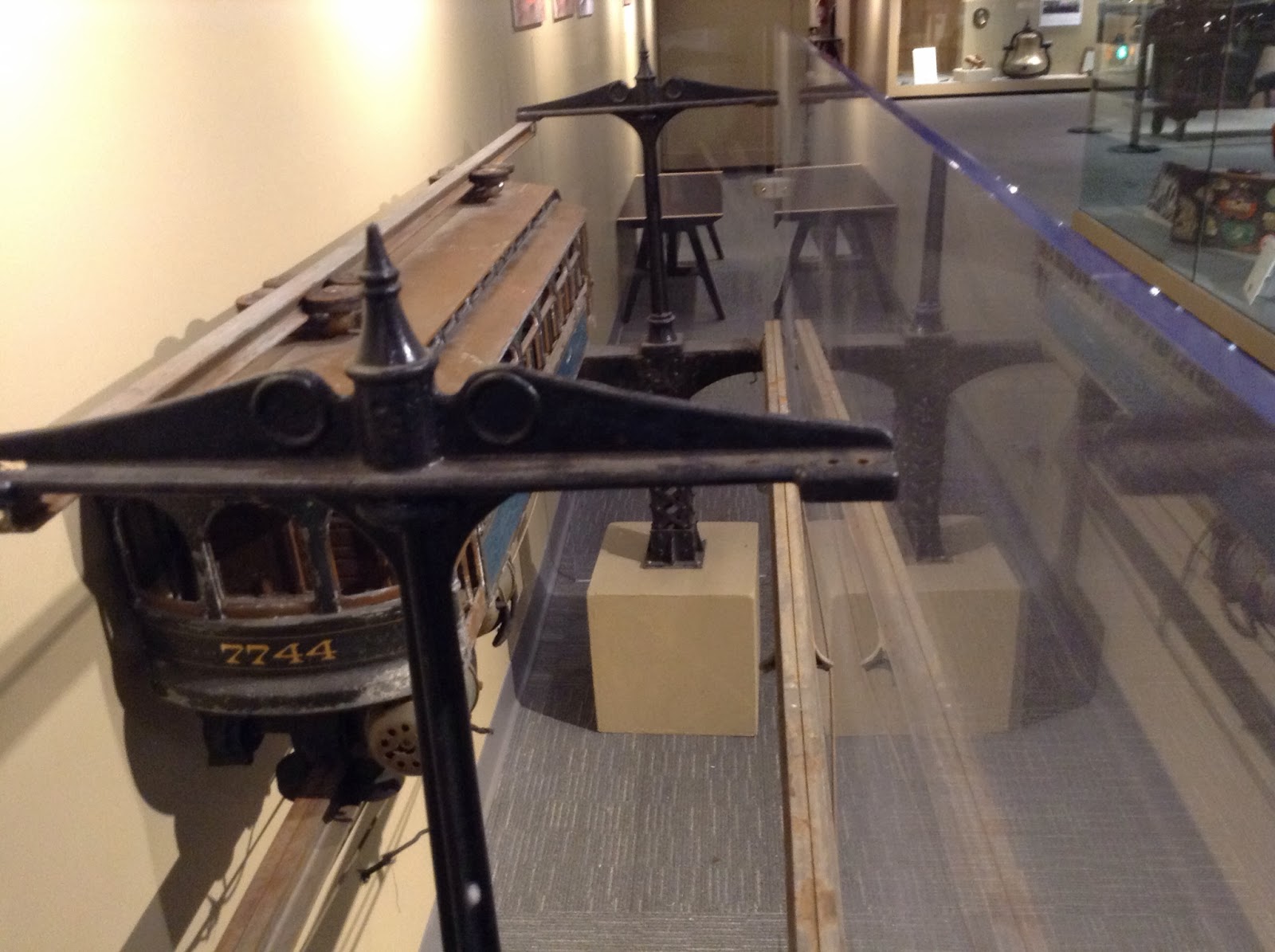
On the next floor, there was a large exhibit on railroads. This is a model of a monorail design proposed for Detroit in 1918...


A second model train display had been installed in the basement, near the streets of yesteryear. The lights and model trains (and a train-themed playlist) activate once someone enters the room. One of the trains had a small video camera mounted on it, which displayed in real time on a couple of tv sets mounted above. It was reminiscent of the scene in the Addams Family movie when Gomez Addams takes out his frustrations on his model train set.

All things considered, the Detroit Historical Society is well worth a visit if you're passing through the city, for the perspective it provides on the growth and subsequent decline of the Queen of the Rust Belt.