Showing posts with label First Siege anniversary. Show all posts

Thursday, May 23, 2013

Estimating Combat Strength at Fort Meigs, May 1813

 Colonel John Miller's detachment forms up for a charge under the cover of Fort Meigs' south wall. These 350 men were formed up in a single line of two battalions and one company.

Trying to estimate exactly how many troops General William Henry Harrison had available at Fort Meigs is like herding cats. Even the officers on the scene had a difficult time tabulating their combat strength. Secretary of War General John Armstrong was a micro manager, and expected detailed reports of how many men were present in the field. I have even seen documents where his Adjutant, General Cushing, ordered copies of company-level rolls to be sent to the War Department, monthly. From his office in Washington City, with a handful of clerks and staff officers, Secretary Armstrong was trying to coordinate several field armies and 9 military districts. 

During the late spring of 1813, Secretary Armstrong authorized a total of 7 infantry regiments (each with 10 companies and approx. 1000 men) to join the Northwest Army in the 8th Military District led by General Harrison. Two of these regiments, the 17th and 19th, were already present, but at minimal strength. At Fort Meigs in May, they formed a weak battalion. Another, the 24th Regiment of Infantry, was marching north from Tennessee with about 400 men. The 26th, 27th, and 28th Regiments were being recruited with one-year enlistments in Kentucky and Ohio, while the 17th and 19th sent parties to replenish their ranks from the same region. The seventh regular regiment seems to have been a Rifle unit. As the recruiting drive was going on, Armstrong discouraged Harrison from raising shorter-term militia regiments. 

Not only were the militia regiments seen as a waste of material and pay, but they would be mustered out of service before they could be used for the invasion of Canada. However, Harrison was forced to appeal to Ohio and Kentucky governors Meigs and Shelby to raise troops for the defense of Fort Meigs. As troops were continually moving into and back out of the fort, and small detachments and sick men were scattered everywhere, it was very difficult for the commanders to see how many troops they actually had at the front at any one time. Harrison ordered General Green Clay, in command at Meigs, to give him a report of how many troops were there at the end of the month. This document survives in microfilm at least, although it is very hard to read.

I have gone through and extracted the total strengths of the units posted at Fort Meigs, in order to give a better idea of how many men where stationed there after the siege. Colonel John Miller commanded the combined 17th and 19th US Infantry, while the illegible militia regiment may have been the survivors of Clay's Brigade:
Regiment Officers Present Enlisted Present Officers Sick Enlisted Sick Total
Field and Staff 4


4 officers
Col. Miller's 12 162 (32 NCOs) 6 209 (38 NCOs) 21 officers
441 enlisted
Col. ???'s 25 335 (61) 9 192 (23) 34 officers
611 enlisted
Col. Mills 8 77 (22) 6 78 (23) 14 officers
200 enlisted
Maj. Peter's 8 64 (20) 2 36 (8) 10 officers
128 enlisted
Maj. Alexander's 5 49 (11) 4 41 (11) 9 officers
112 enlisted
Capt. Cushing's 1 32 (10) 0 20 (3) 1 officer
65 enlisted
Total 59 719 (156) 27 576 (106) 93 officers
1557 enlisted
Total from muster


1751 enlisted
2148 enlisted (absent or accounted for)

For practical purposes, I have also attempted to determine how many line companies (the basic combat unit) were present by counting Captains and Sergeants. Each company was authorized 4 Sergeants, and since these men were simply promoted from the rank and file by their company officers, they are probably the best barometer of how many distinct fighting companies were available at the Fort. I've also provided an aggregate of fighting men for each regiment, though companies did vary considerably in strength.

Counting Heads:
Unit Captains Sergeants Est. Companies/ strength
Regulars (17th and 19th) 5 29 7 (441 muskets)
X militia 9 38 9 (611 muskets)
Col. Mills' Ohio Regiment 3 (7 absent) 20 (24 absent) 3 present (200 muskets)
7 absent
Maj. Peters Ohio Regiment 3 14 3 present (128 muskets)
Maj. Alexander's Blues 2 (1 acting Major) 12 3 present (112 muskets)
Cushing's Company 1 4 1 present (65 muskets)
Total 23 Captains 117 33 companies
1557 muskets or rifles
(minus music)

The above figures leave the question, what combat troops were part of the garrison of Fort Meigs during the Siege? Thanks to an analysis of primary sources done by Dr. Eugene Watson during his time as site staff of Fort Meigs Historic Site, as well as my own analysis of primary documents, we can make a rough estimate of the Order of Battle for the American garrison during the siege. I'll arrange the OOB by seniority of service branch, then regiment and include approximate overall strength and number of companies present.

For wargamers, companies should be regarded as the equivalent of a platoon in modern warfare. At Fort Meigs, they were understrength and organized into provisional battalions.

Unit
Role and Arms
Strength
Companies
Staff


Major James V. Ball's squadron, United States Light Dragoons
(2nd US LD and volunteers)
Light Cavalry: sabres, pistols, carbines and muskets.
220
5
Captain Daniel Cushing's Company, 2nd US Artillery
Foot Artillery: heavy and light cannon, muskets.
80-90 (including attached troops)
1
Colonel John Miller's battalion, US Regular Infantry
Infantry: muskets.
200-300
6 (one light infantry)
Major John Alexander's battalion, US 12-months volunteers
Light Infantry: 2 cos muskets, 1 co rifles.
200
3
Captain Peter's Scouts and Spies
Scouts: rifles.
30
1
Indian Guides
Scouts: rifles.
30
1
Col. James Mills' 1st Regiment, Ohio Volunteer Militia
Infantry: rifles and muskets.
100-200
3 (two rifle)
Col. Mills Stephenson's 2nd Regiment, Ohio Volunteer Militia
Infantry: rifles and muskets.
80-90
3
Major Johnson's Battalion, 10th Regiment Kentucky Volunteer Militia
Infantry: muskets.
300
3
Approx. totals


1240
26 companies, viz:
5 cavalry
1 artillery
4 rifles
6 light infantry
10 line infantry

Sunday, May 19, 2013

Another Account of the Battle of the Rapids


I was looking through digitized versions of the Kentucky Gazette, printed in Lexington Kentucky 200 years ago, and came upon this account of Dudley's Massacre by an anonymous participant. It is an extract of a letter written by a Kentucky militia officer on May 9, and printed in the Gazette on May 18, 1813:
Of the several battles fought on the 5th, you have been informed. Although made to retreat by the thousands of Indians they had around us, we compelled them to raise the siege; and the Indians, we are induced to believe, are leaving them rapidly. The British permitted them to murder not only our wounded, whose cries were heard all night by our centinals at their posts, but even many of the prisoners. This information, at least the latter part, we have from a couple of Canadians, who left the British and swam over to us in the night: finding other information they gave us correct, we have no doubt of that. We had several interviews before they left us, with a flag. I accompanied it in hops to meet Shelby, even in presence of his honor Gen. Procter, who is the most savage looking rascal I ever saw. Carr and Underwood are with him. I escaped, after having the pleasure of breaking 3 bayonets in their cannon, and should have succeeded in blowing up their magazine, had I not been prevented by Col. Dudley, who was under the impression, we ought to retain the place. The intention of Gen. Harrison war for us to retreat, as soon as we had spiked the cannon, which we succeeded in doing; but Col. Dudley permitted a few Indians to lead him into the woods, and keep him employed until a reinforcement was sent from the old British garrison, two miles below--two attacks were made at the same time on this side. The plan was an excellent one, had it been executed.
The enemy had, in regulars, Canadians, and Indians about 3000 men; we could spare from the fort about 16 or 1700--eight hundred were ordered to land above the fort, to surprise and spike the cannon before a reinforcement could get up from the garrison, and then retreat to the boats, which command was given to Col. Dudley, who thought because we drove them from their batteries they were of course whipped; he followed them into the woods, and permitted his troops to get scattered, adn was completely cut off, myself and lieut. Sanders excepted, with about 160 who are all that have returned--we have some hopes a few may have gone up the river-- They have about 350 prisoners--their names they promised to give us, but never did. The prisoners will reach you in a few days by the river Huron, to which place we furnished boats for their transportation and provision. The work that has been done since the sige (sic) commenced would surprise you--we all live under ground, or did, till this morning, when after formally demanding a surrender, the enemy retired in disgust.

Saturday, May 11, 2013

Evaluating the Siege of Fort Meigs


From a Kentucky officer's account published in the Analytical Magazine, 1819:
From the first to the fifth of May, there were between 5 and 600 cannon balls and bombs fired from the British batteries each day. The number killed in the fort, was ten with cannon balls and bombs, and that number with small arms. During the siege, there were three or four men posted on top of the traverses--these men, as soon as they saw the smoke gushing from the mouth of the enemies cannon, would cry out shot!! or bomb!! as the case might be. This arrangement was a wise one, for it saved the lives of many; by it, the garrison were enabled to fall in the trenches, before the shot reached the fort. So frequent did we hear the word shot!! that the motion of the men might be very well said to resemble that of a sawyer, bobbing up and down by the force of the current. We were very much annoyed by the falling of bomb shells, which made it necessary to burrow; but these were very damp and unwholesome; indeed, we were kept out of the water, while in many of them, by laying our blankets on a floor of poles and bark.
The number killed in the two sorties on the south side of the river and in the fort, has been estimated at 81, and 189 wounded; this number, I am induced to believe, is too small by at least 40 or 50 killed, and an equal proportion in wounded. How many of the enemy were killed on the south side, it is impossible to say, as the enemy kept the ground; but our men were first rate shooters, and fought in open order, behind trees and stumps, logs, &c. and frequently within 60 or 80 steps of the enemy, and for a short time within about 30. And as they had been subject to the roar of cannon and small arms for eight days, with the sight of many killed and wounded; the first fright must have been over, if this latter is at all to be applied them--it is reasonable then to suppose that the enemy suffered much.* 
The account given of the killed on the north, is believed to be too small. The detachment consisted of 880**, of which number, 500 , or thereabouts, were paroled and sent to Kentucky; 192 made their escape to Fort Meigs, 15 to Defiance, and 30 were taken off by the Indians, which leaves the number of killed about 143.
S.

*Official British reports stated that 14 men were killed in action, 47 WIA, and 41 captured. However, the casualty lists were for the British regulars and militia, and do not account for the Indians, who bore the brunt of the fighting on May 5 1813 and kept close to the fort when skirmishing.

** Colonel Dudley commanded his entire regiment, plus Thomas' company and Gilbraith's scouts who accidentally landed on his side of the river, plus Captain Samuel Price's company of the US Light Artillery, fighting as infantry and half a dozen Shawnee scouts.

The next article in the magazine concerned a newfangled invention known as a "velocipede". Would they ever catch on?

Wednesday, May 1, 2013

Fort Meigs-- 1 May 1813


On this day, the bombardment of Fort Meigs by the British army commenced.

From the notebook of Major Chambers, 41st Regt.:
1st May 10 o'clock A.M. On a signal fired from the Myers the Batteries opened, consisted of one Battery of 2-24 Pounders and one 8 Inch Howitzer--- One Mortar D [ditto] of 2--51/2 inch, one Battery of two 12 Pounders and a Battery called the Sailors of one 12 Pounder--We expected great effect from our Guns, we were much disappointed the Enemy had  thrown up an Empailment [emplacement] which in a great measure sheltered them from our fire, and there were a great number of Traverses within their Fort. The Enemy fired occasionally at us without doing any injury.
 Captain Wood recorded that the traverses were finished just in time:
This particular peice of work was completed early on the morning of the first of May, just as it was discovered that  the enemy had finished three of his principal batteries had got his guns in, was then loading and bringing them to battery; when orders were directly given for all the tents in front [of the traverse] to be instantly struck and carried into the rear... and that beautiful prospect of beating up our quarters, which but an instant before presented itself to the view of the eager and skilful artillerists, had now entirely fled, and in its place suddenly appeared an immense shield of earth, obscuring from his sight every tent, every horse (of which there were 200) and every creature belonging to the camp.
 Captain Cushing's diary:
Saturday, May 1st-- At 2 o'clock in the morning the British opened their artillery upon our garrison from their gun-boats, which lay one and one-half miles below us, but it was without effect. At 8 o'clock they hoisted the red flag at their lower battery and commenced firing with 24, 12 and 6 pounders, and eight inch mortars. They fired at us this day 240 shot and shells; did very little damage. They continued firing shells through the night but not often, just enough to keep our camp from rest. We keep up a heavy fire on them all day from different parts of our camp, the Indians are very thick on our flank and in our rear. We have not more than two killed and four wounded today.
  From the memoirs of Adjutant Alexander Bourne, Ohio Militia:
Just before night [on April 30], the Adjutant Genl. informed, that I was appointed Adjutant of the day for the next 24 hours, & Major [John] Alexander of the Volunteers, field Officer of the day--& requested me to inform him of it-- I found him in the Marque of Col. [John] Miller [19th US Infantry], drinking brandy--He said he was unfit for duty, & I ought to have told him sooner--I told him I had just been informed of it myself--& as it was nearly dark, nobody would perceive his inebriety--& that I would attend to his duties, as far as it was admissible & taking him by the arm, we went to his marque & sat down--he lamenting his situation, & I cheering him up--
It  had become very dark, & we heard the report of a large cannon--I told him that it was from the enemy, & that we must go to head quarters immediately for special orders--he was afraid his situation would be discovered. I told him there was no alternative, if he did not go, he would be sent for, & we then went--The General was standing in his marque, surrounded by his staff--He asked me if I was on duty? I told him I was--He then said, "put out every light in the camp," "that the enemy may lose his aim"--
 ...I executed the order & returned to head quarters--when the General & staff, & all the Officers on duty, set out on the grand rounds, to see that all the guards were wide awake--It was extremely dark, wet, & muddy--we often fell down in the ditches--sometimes one or two upon the top of another-- the British firing slowly, without the least effect--for all their balls struck the bluff below us...
...The next morning the enemy opened all his batteries, & poured in a constant stream of 24 pound balls & 10 [8] inch bomb shells--his balls generally going through the front pickets above our heads & lodging in the traverse bank-- the shells falling & bursting, part of them inside of the fort, & the others outside-- We soon had a few men killed & wounded, & some mangled in a shocking manner, which was very revolting to my feelings at first--but I soon become accustomed to it...

Tuesday, April 30, 2013

Fort Meigs-- 30 April 1813


The race to build gun emplacements on one side, and earthworks on the other side of the river, continued this day, as Indian sharpshooters continued to pelt the fort with musket and rifle balls.

From Major Chambers' notes:
30th I accompanied Lt. Colonel Warburton and made a reconnaissance on the Enemy's side approached so near to their Fort that the Riflemen fired several shot at us. I fired one shot at a number I perceived together with my Rifle (one that General Brock presented me with).
Four Ottawa Boys intercepted the Sandusky Mail, it was guarded by three men who fled as soon as the Boys fired, the Eldest Boy was only fourteen years of age.
7 o'clock PM went on Board the Myers Gun Boat and in company with the Eliza ascended the River about half a mile fired a shot from the 9 Pounder every half hour the enemy did not fire a shot at us.
 From the National Intelligencer, 10 May 1813:
Some persons had gone within two miles of the Fort, and one ventured within half a mile, and so near, as distinctly to see the flash of the cannon through the trees...
 From Captain Cushing's Diary:
Friday, 30th-- We have been all day employed in traversing through the camp, playing upon their batteries with our eighteen pounders and throwing grape and canister shot at the Indians which are in our rear and on our flanks. We have had one man killed and 6 or 7 wounded by the Indians this day.
 From Private Shadrach Byfield, 41st Regiment of Foot (the target of Captain Cushing's cannon):
Sergeant Smith ordered me to go to the other battery, and let the artillery officer know that the work was ready for the platform; and as I came up from the work, I looked towards the fort and saw a smoke ascend, and then fell to the ground; when a ball passed over me and struck into the earth.
  From Private Nathaniel Vernon, Pittsburg Blues (a target of the Indians):
“Hurrah!” said I, “Sergeant, what does that mean?” He pointed to a tree at considerable distance from the pickets, where I observed an Indian perched in one of the branches. He said with great humor: “That rascal, George, has been firing at me ever since I commenced cooking my breakfast.” I swallowed up my tin cup of coffee, pretty expeditiously, during which however, I think he fired once or twice, and told Trovillo I was not going to remain a target for the yellowskins.

Monday, April 29, 2013

Fort Meigs--29 April 1813

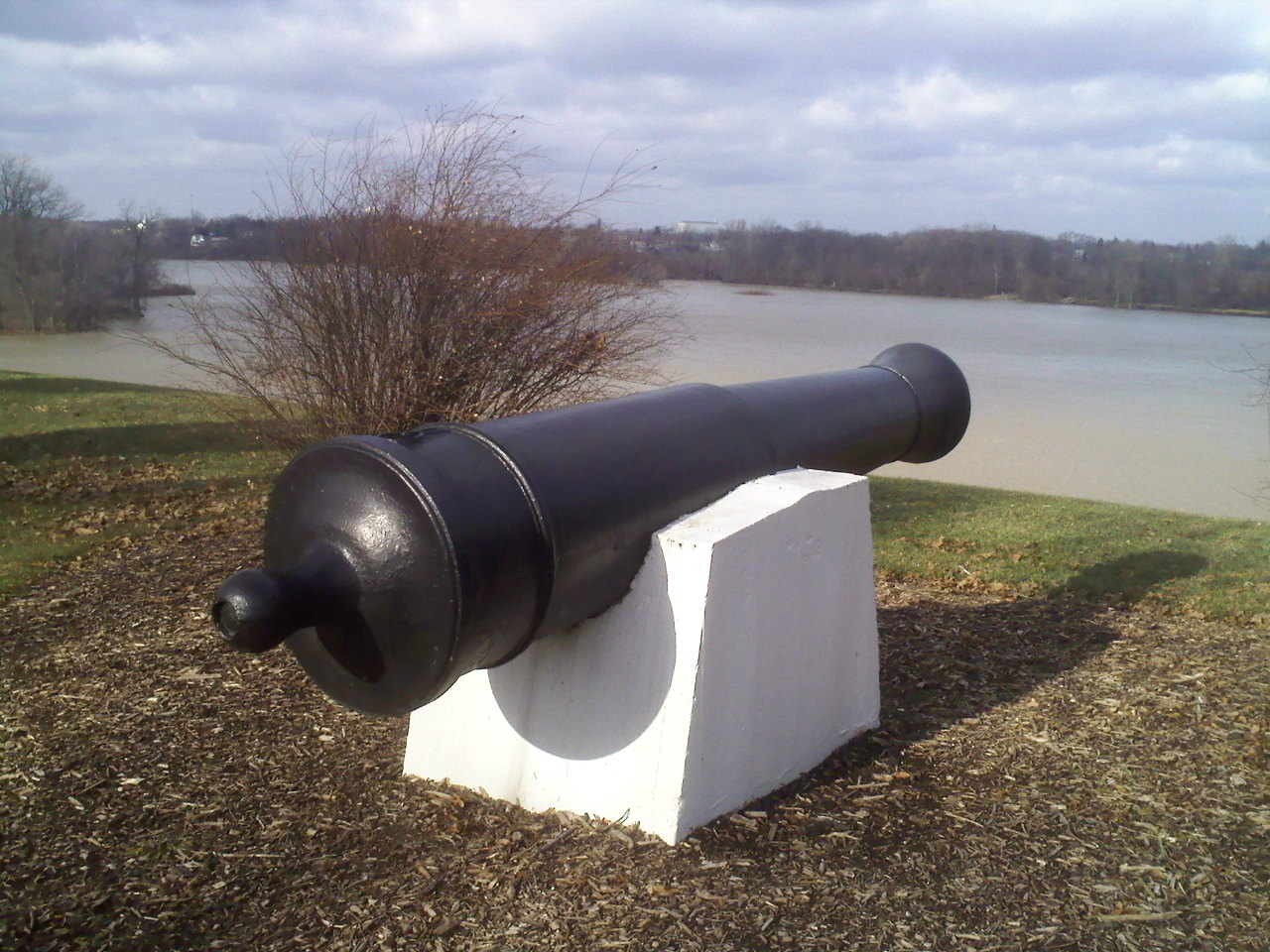
 A 24-pounder cannon overlooks the Maumee River. It was near this spot on the opposite bank that the British hauled two 24-pounders through mud into a position to bombard the American camp.

Blogging the siege of Fort Meigs has been tiring, especially since many of the primary sources and accounts contain slight discrepancies in chronology. The journal of Major Peter Chambers actually seem to be notes that were jotted down as he supervised many of the operations. As we shall see from his notes and other reports, he also played an important role in the combat around the fort by leading from the front.

From Major Chambers notes:
29 A number of Shawonies, Winabagoes Kickapoos killed several Pigs and Oxen under the Enemies Guns. 8 o'clock P.M. all hands to the 24 Pdrs and after a hard struggle succeeded in transporting them to the Batteries (which were this day completed). In the course of the night got up an 8 Inch Howitzer and all the platforms except two the two 12 Pons [12-pounder guns] and two Sixes two 51/2 inch Mortars were all taken up.
 According to John Richardson, who was serving as a "gentleman volunteer" with the 41st Regiment, it took two oxen and two hundred men to pull the two biggest cannons up the river bluff. The mud, he wrote, was up to the axles of the gun carriages. 

The Americans kept up a harassing fire from their own big guns in the fort. However, they were unable to destroy the British work parties because their supplies of 18- and 12-pound cannon balls were running very short. Major Amos Stoddard started the siege with little more than 300 18-pound shot, and even less for the 12-pounder guns. At least, as we shall see, the Americans were about to be resupplied with the latter type.

From Captain Cushing's journal:
Thursday 29th-- This day we are employed in finishing the traverse and making ready for battle, for we have been surrounded by British and Indians for two days. We let loose our cannonade on them yesterday and have kept it up by spells all this day, and shall let loose upon them this evening with an eighteen pounder that is already elevated.

Sunday, April 28, 2013

Siege of Fort Meigs--April 28, 1813


From the diary of Captain E.D. Wood:
...It became necessary to intrench the army entirely anew, which of course must be done within the original lines of the camp. A plan for a kind of intrenched citadel had been some time before arranged and recommended by Captain Wood of the engineers to General Harrison as the only effectual security for the army in case the enemy should attack with artillery... On the 28th in the morning the whole army was set to work, and continued in the trenches until "tattoo"; when on account of darkness and rain...the troops were accordingly dismissed with directions to the different commandants of parties to resume their stations in the trenches again at break of day...
...The Indians had now become extremely troublesome; there was not a stump, bush, or log, within musket shot of the camp, but what shielded its man, and some of them two or three. Unfortunately, we had not been able to clear the wood away to a sufficient distance, on our left, of which circumstance those demons of the forest very readily availed themselves, and, instead of remaining idle at the foot of the trees, they bounced into their tops, with as much agility and dexterity as if they had been taught it from their infancy; and from those elevated stations, poured down into our camp prodigious showers of musketry; but the distance being so great, out of the numerous quantity  of  balls received in camp, but very few took effect...
From the Diary of Captain Daniel Cushing:
Wednesday, 28th.--Last night we had the heaviest rain that I ever knew and very hard thunder. This morning we had the pleasure of seeing about 300 British down the river and a number of Indians and British came opposite to our fort and fired at our men that were on the river bottom. I gave them one shot with an eighteen pounder which made them leave their stations. Captain Hamilton was sent down the river this morning--he reported that the British had landed on the other side about 1,500 or 2,000. We expect a hard fight this night. I completed the abatis this evening in front of the grand battery. The whole army was at work this day, one third at a time, heaving up a traverse through the camp. A party of dragoons rode out a short distance from camp this evening; one of them received a ball in his arm from the rifle of an Indian--there was a party watching for our men.
 From Major Chambers Journal:
28 Left this Encampment and encamped at the Old British Fort. The Indians cross'd to the Enemy's side and kill'd a number of Hogs & Bullocks, took several Horses--from under the very Guns of the Fort. Extremely engaged all Day in Transporting our Stores for the intended Batteries.
 From An Anonymous Ohio Militiaman:
28th Mounted guard at gate at 10 the Indians began to fire the across the river saw 6 Indians more going round the fort (gates all shut) some balls falling in the fort
some men are now afraid to be seen in bodys by our bulldogs
one third of each company employed in throwing up entrenchments in the garrison
some troopers went out to reconoiter were fired on by the Indians they returned everyman to his post at 10 P.
  From Captain Robert B. McAfee's History of the Late War:
An express was now sent to general Clay, with letters also for the governors of Ohio and Kentucky. This perilous journey was undertaken by captain [William] Oliver, the commissary to the fort, a brave and intelligent officer, who possessed every necessary qualification for such an enterprise. He was accompanied by a single white man, and an Indian, and was escorted some distance from camp by captain Garrard with 80 of his dragoons.
From a letter to Ohio Governor Return Jonathan Meigs from General Harrison:
 The enemy are determined to put their threats in execution their columns are now in sight and their Gun Boats with their artillery &c about two miles from us and the woods on both sides of the river are full of Indians. I send this by a confidential person, Mr. Oliver, who will take it on as far as he thinks proper. Be pleased to write immediately to the Governor of Kentucky—my men are in fine spirits, do not my dear sir doubt the results—the enemy little dream of the bitter pill I have prepared for them. In a little time I hope to be able to inform you of their complete discomfiture...

Saturday, April 27, 2013

Siege of Fort Meigs--April 27, 1813


The first day of combat during the siege of the fort. Quite a lot happened over the next two days as Procter and Tecumseh's armies surrounded the stockade and cut the garrison off from outside aid.

From an anonymous Ohio militiaman's diary:
27th half past 3 AM an alarm by centinal firing took our post as before dismissed to our tents to rest on our arms about 11 AM fishers fired on across the river with out effect one of our buldogs saw them and began to bark & it was supposed that their intent was offensive and Infected some of them recieved orders to kindle fires as before came on guard at 5 PM continued till near day.

From Major Peter Chamber's Journal:
27 Embarked and arrived at Swan Creek 4 miles from Point au Chene, held a Council with the Indians. Plan of operations agreed upon. 12 o'clock left Swan Creek and Encamped at a small River about 4 miles from the old British Fort.
From Captain Daniel Cushing's Diary:
[When another British scouting party showed itself on April 27] I took good aim at them, the ball struck just over them, they fell down at the flash, they lay still until I had loaded again, and Capt. Wood had loaded his eighteen pounder in his loft. At length they started for the woods. Capt. Wood gave them a shot and I followed suit. They both struck very close to them; there were fourteen seen there before we fired, and but 12 remained in the old fort, where the remainder of the party were plain to be seen with a spy glass. This is the first time I have discharged  a piece at an enemy in 30 years.
From the Ohio Fredonian, 7 June 1813:
 Two elegant shots were made at them. They were supposed to strike within 3 or 4 feet, and covered them with dirt.
 From Captain E.D. Wood's Diary:
The next morning sixty or eighty dragoons were despatched a short distance down the river to see what the enemy were about. They had proceeded but a short distance before they met the Indians, who by their manoeuvering manifested a design of getting into the rear of the dragoons, which the intrepid Lieutenant who commanded the party did not altogether like so well; he therefore opposed a counter manoeuvre by bringing his men suddenly to the right about and hastening expeditiously back to camp, where he arrived safe with only one man slightly wounded. This was certainly the best thing he could have done.
From a letter from Dr. Charles Marion to Lt. Joseph H Larwill:
As to the siege I have not time to be particular at present, the Indians began to annoy us on the 27th April.


Friday, April 26, 2013

Siege of Fort Meigs-- April 26, 1813


 Looking at the spot where British officers scouted the camp, from Captain Croghan's Battery at Fort Meigs.

From Major Peter L Chambers' journal:
26th Went to the Foot of the Rapids to reconiter the Enemy's position, and decided for the situation of the Batterys.  The Enemy appeared to be in numbers, a large quantity of Pigs, Horses and Cattle were driven in by the Enemy on discovering us. Tecumthe and his Brother the Prophet arrived and 11- or 1200 Indians.

From a letter by Captain Daniel S. Cushing:
...On the 26th, the Indians and British began to show them Selves on the opposite Side of the River...

From the Journal of Captain Eleazar D Wood:
On the 26th, in the afternoon, a party of horsemen, consisting of about fifteen or twenty English officers and Indians, debouched from the woods upon a small plain on the opposite side of the river, and galloped over it apparently with a design of examining its local position, and to select suitable sites for the placing of their batteries. Our guns were all instantly loaded; but before we could get ready to pay due honor to these new guests they thought proper to dispense with all ceremony on that occasion and to be off.
 

From an anonymous Ohio militiaman's diary:
26th Cloudy dragoons sent returned without discovery at 12 all ordered on fatigue.  
The guard some getting wood and some to fortify the fort at 4 PM... 
the river for British and Indians their appearance on the other side the...  
one of bulldogs raised a tremendous growl and they scampered off orders to make ... 
150 yards from the fort their guard thought they saw Indians fired and precipitate retreat Ensued all placed at their alarm post the rifle company have all drawn muskets had to take his rifle in one hand and his musket in the other and stand at his post hole with a covert...  
ing and had the enemy attempted to scale the pickets (and which we expected they would attempt) we would then have g them a warm reception the rifles first fired then muskets then fall back and load our rifles the Volunteers to step forward and fire we then to advance and fire again if they attempted to scale about 8 PM dismissed.
 

Thursday, April 25, 2013

Siege of Fort Meigs-- April 25, 1813


Not much occurred today, as General Procter's expedition landed near the outlet of the Maumee River and made camp. General Harrison, sensing something was up, sent a scouting party down river.

From Captain E.D. Wood's Journal:
On the 25th a scouting party was sent down to Presque Isle, to see if any discoveries could be made of the approach of the enemy, which party returned in the afternoon of the same day, and reported that they saw several tents pitched upon the west side of the river, and two or three sail boats off the mouth of the bay.

Wednesday, April 24, 2013

Siege of Fort Meigs: April 24

 © RĂ©mi Jouan, CC-BY-SA, GNU Free Documentation License, Wikimedia Commons

 A British Fleet Departs to Invade Ohio

200 years ago today, a British squadron weighed anchor in the Detroit River and sailed south across the western end of Lake Erie to the mouth of the Maumee River. 

They had a large fleet, composed of two brigs, four schooners, and two gunboats as well as a swarm of smaller open boats. Brigadier General Henry Procter's small army of about 500 regular soldiers from the 41st Regiment of Foot and 400 Canadian militia from three different militia regiments climbed aboard. They also packed a powerful train of artillery, including two massive 24-pounder siege guns and several 8-inch howitzers.

Journal of Major Peter L Chambers, 1st Battalion, 41st Regiment of Foot. Deputy Assistant Quartermaster General to the British Right Division:

Sailed from hence at 10 o'clock A.M. Same night arrived at the Miamis, disembark'd the next day and camped at Point au Chene.
"Point au Chene" is Oak Point in French. I'm not sure if there is a modern place called by this name, but the spot was somewhere on the shore of Maumee Bay. 

It was near the mouth of the Maumee River that the British and Canadian troops met their Indian allies: about 1200 warriors from almost all the nations of the Northwestern frontier, led by Chief Tecumseh. Among his most notable followers were the Wyandot chiefs Walk-in-the-Water and Roundhead, as well as the Sac leader Black Hawk.

Meantime, at Fort Meigs General Harrison had arrived, along with most of the troops who had been rushed up to augment the scarecrow garrison:

Head Quarters Camp Meigs April 24th 1813
 Genl Orders
                  The whole of the Troops at this place Major Johnsons command excepted will be mustered & inspected and inspected on the last day of the present month all the Non-commissioned Officers & Privates on Extra duty will on that day Join their respective Companies-- The Commandants of Corps will apply to Major Hukile [Major Levi Hukill, 2nd US Light Dragoons] for blank Muster Rolls-- It is expected by the General that the Arms, Accoutrements, Clothing of the men will be in the most complete Order-- The General has again to complain of the inattention to the Police of the Camp-- The regulations for the preservation of Cleanliness must be better observed--It shall be the duty of the Officer of the day to point out to the commanding Officers of Corps any defect as to the police of the part of the Camp under their Control-- And if any such defect or nuisance is not immediately removed the Officer of the day will report the Officer neglecting it to the General...
...No Noncommissioned Officer or Private is to be suffered to go to fish without taking his Arms nor are any to be allowed to go further down the river than the lower part of the first Bottom below the Camp nor above more than half a mile from the landing nor is any one to cross the river without permission from the General-- No fishing will be allowed until after Seven O'Clock in the morning--

Tuesday, April 23, 2013

Siege of Fort Meigs: April 23, 1813


From the journal of Captain Eleazar Darby Wood, US Corps of Engineers:
...It was now all but certain that the place would soon be invested, for we recieved information that the enemy were assembling in great force at Sandwich [modern day Windsor, ON], and that a large number of Indians had just arrived at Detroit from St. Joseph and the neighborhood of Mackinaw.

Small parties of scattering Indians were constantly round the camp, whose object it seemed to be presumably to take prisoners, as we supposed, for the purpose of obtaining information relative to our strength and situation, and which, as we afterwards learned, was actually the case.

Our block-houses, batteries, magazines and connecting lines of defense were now generally completed; and the appearance of the camp, in every direction, was such as to inspire confidence in the minds of those whose duty it had become either to defend, or with it throw themselves into the hands of an English savage...

 --from Wood, Eleazer Derby. Journal of the Northwestern Campaign of 1812-13: Under Major-General William H. Harrison. Defiance, O.: Defiance College Press, 1975 pg. 16. 

A letter from Captain Daniel L. Cushing, 2nd US Regiment of Artillery to 1st Lt. Joseph H Larwill, 2nd Artillery:
Fort Megs Apl 23th 1813
Dear Lieutenant
I Recivd your Letter this day by mule, dated 7th Instance at Wooster, I was very glad to hear from you, but was sorry to hear of your indisposition, I received a  Letter yesterday from Leut Meek dated the 3 of this month he wrights me that he is not will yet, but States that Dr Elison is puting Meddison in Side and blisters out Side, which he hopes will Cure him Shortly...
We have at this time about 1600 effective men, prehap more a good maney more would turn out in Case of an alarum--we feel ourselves perfectly Secure from the Enemy, we have built two Strong batterys in addission to the two that was built before you Left hear...
 The "Lower Blockhouse" today.
...the Lower block house on the pint we have Converted into a battery by taking off the Ruff, Lowring the upper flower about 3 feet, building up a brestwork of dirt on the out Side, and planting an 18# in it which commands the high nob ajasent to it...
...I have nothing more to wright, give my Respects to your brother and all friends you See, with profound Respect I Remaine yours etc
Danl Cushing
from  Cushing, Daniel Lewis, Harlow Lindley, and Daniel Lewis Cushing. Fort Meigs and the War of 1812, Orderly Book of Cushing's Company, 2nd U.S. Artillery, April 1813-February 1814: And Personal Diary of Captain Daniel Cushing, October 1812-July 1813. Columbus: Ohio Historical Society, 1975. pg. 141-42.

Monday, April 22, 2013

Gaming and Reenacting the War of 1812

The bicentennial of the Battle of Fort Meigs is fast approaching, and as I have been busy working on other projects and starting a new position at work, I've been trying to keep up with my War of 1812 research &c.

One small project that I've been hoping to accomplish this year is to "live-blog" the First Siege of Fort Meigs. From April 24 (the date that the British invasion fleet sailed for Ohio) to May 9 (when the British boarded their ships and retreated back to Canada) I will make daily blog posts of contemporary journals, reports and accounts of the siege.

General Henry Procter's first expedition into Ohio was the largest sustained military operation by an enemy force into the state, except for the raid of General John Hunt Morgan's Confederate cavalry division in 1863. Although the British had forced a series of American surrenders in 1812 and early 1813, they were unable to break the American marshaling point at Fort Meigs, which ultimately doomed their efforts to defend the Detroit frontier.

I've also been playing around with an 1812 war game of my own devising. One of the things I've noticed is that infantry battles tend to go better for whoever fires a volley first.


I had a scenario set up so that a British force would force a bridge crossing and attack an American detachment entrenched near a farmstead. It proved more expedient to send the bulk of the British forces upstream to outflank the American breastworks.

The Shawnee band at top is small, 20 men left out of 40, but armed with rifles and good marksmen. They managed to take out a howitzer before I realized I had mistaken the "soldier" roll for a "cannon" hit on the dice. They were wiped out next turn, but not before distracting most of the Kentucky militia.

While the Kentuckians were distracted near the bridge, most of the rest of the British forces outflanked the Americans and drove them from their breastworks, which are useless when they face the wrong direction. 

The Americans hastily formed a new line perpendicular to their entrenchments, but the Canadians on the right have brought along a cannon. I'm considering rules that allow a cannon to bounce its shot along several connecting targets, which would be devastating in this situation. The Kentucky riflemen on the left are on a hill, which gives them +1 to shoot, but the Wyandot warriors are protected by the breastwork they just captured.

The battle ended quickly once the Americans stabilized their line and brought in their guns and riflemen from the left. Victory conditions are a bit tricky, since the Americans started out in a better position (a lucky howitzer round landed on the British light company and destroyed them to a man early in the game). As in the real war, there was no clear victor this time, but the British suffered the loss of most of their best companies before pulling back.

So far, this game plays pretty fast and furious, with tactical advantages changing hands rapidly. It seems true to my experiences of actually going out with a musket or serving on a gun during a battle reenactment, where battalions and companies move back and forth and often get whittled down considerably or even surrounded. That also dovetails with what I know from researching original accounts of small skirmishes, where a couple of infantry companies would chase and clash with each other through a maze of forest or the confines of a farm. I'm thinking of coming up with rules for a battalion and brigade-level wargame, to deal with bigger battles such as Lundy's Lane or Chrysler's Farm.