Showing posts with label New York City. Show all posts

Monday, May 5, 2014

Underwater Terror!


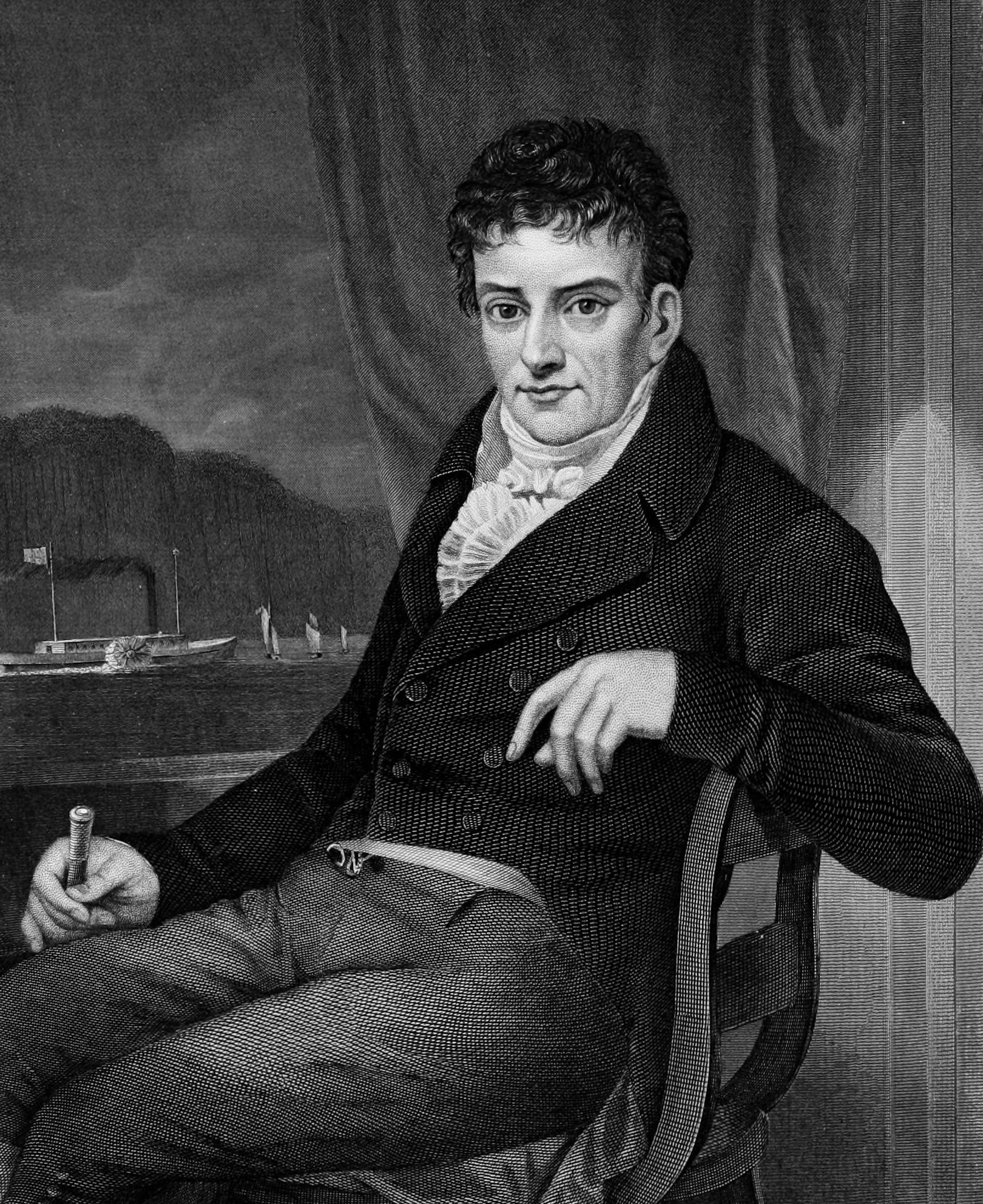
In 1813 steamboat engineer and businessman Robert Fulton wrote a series of letters to retired President Thomas Jefferson regarding his proposals for a new kind of naval weapon. He had discovered that cannon could be shot underwater, with devastating effect at close range on a target vessels hull. This was accomplished by loading a cannon, with enough wadding to keep the powder dry and a tin or brass tube enclosing the priming quill. I believe a lit portfire was dropped from the surface of the water down to the quill to set off the cannon. He also mentions his design for the steam battery Demologos, which would have a unique catamaran design to enclose its vulnerable paddle wheel. When finished in 1815 it could make 2 knots, and while not intended as a seagoing warship, the idea of a travelling, invincible floating fortified coastal battery terrified the Royal Navy.

New York July 8th 1813
Thomas Jefferson Esqr.
     Sir on the fourth inst, I sent you a letter containing drawings, details and observations on my experiments on firing cannon under water, and the consequences of such a mode of conducting maritime war on the preceding pages is an exact copy of Commodore Decatur's opinion in favor of this discovery, which from so experienced an officer must have weight with those who are not familiar with nautical affairs. The object now is to give a fair experiment to this discovery by building a vessel and fitting her in the best manner to secure (illegible) and for which Congress should appropriate 100,000 dollars. In which good work I hope for the friendly aid of your influence on your friends in both houses. Since my last letter to you I have composed the steam engine to work in the ship in such manner that it is within the wooden walls principally below the waterline and out of danger of shot from the enemy. I have this day sent a copy of the commodores opinion to Mr Madison you will have the goodness to send the letter to him, with such opinion of the plan as you think it merits.I am respectfully your most obedient Robt Fulton

Thursday, June 24, 2010

Lego Version of Futurama’s New New York

newnewyork
Matt De Lanoy created a Lego diorama of New York from Futurama. You can explore photo galleries of his creations’ impressive detail on Flicker. He even included the sewer underworld…
sewerfishing
I particularly like the resigned expression on the foot-mutants’ face.

Wednesday, June 16, 2010

Demologos: Voice of the People


demologos_launched 

During the War of 1812-1815, the United States put up a valiant fight against England’s Royal Navy, which at the time was the most powerful fleet in the world. The pride of the small American fleet were its powerful 50-gun frigates, which outmatched their British counterparts. By the end of the war, however, the Royal Navy had improvised a new type of warship, the razee (a third rate ship of the line with its upper gun deck “razed” or cut down to become a large fourth or fifth rate: frigates were considered fifth or sixth rate ships), to counter “pocket battleships” like the Constitution. By the end of the war, nearly all of the American squadrons were bottled up in harbor.

The Americans soon began to develop “secret weapons” to even the playing field: even though many of these infernal devices never saw action, they foreshadowed a different kind of sea warfare. Robert Fulton was coordinating many of these projects: he developed a sea mine as well as a submarine. However, his most dramatic project was the steam frigate Demologos, constructed in New York Harbor between 1813 and 1815 by the Brown brothers shipbuilders (Adam and Noah Brown, who had built Master Commandant O.H. Perry’s squadron on Lake Erie in 1813).

fulton_plan

The Demologos was a giant catamaran, with a boiler and steam engine housed in two hulls. A paddlewheel set between the hulls propelled the vessel. It was built with five-foot oak walls and mounted 16 thirty-two pounder guns. She was also fitted out with lanteen-rigged sails to aid her primitive propulsion system. She was launched in October 1814. After the death of Robert Fulton in February 1815, the steam battery’s name was changed to Fulton, but she was completed too late to see action during the war.

Following the war, she served mainly as a receiving ship (a floating barracks) in New York, until she was blown up in a magazine explosion on June 4, 1829. The construction of her replacement, Fulton II, was supervised by Commodore Matthew Perry, the same officer who opened Japan to foreign trade.

Over the years there has been much speculation over what Demologos would have done had she encountered a British squadron. Although she was described as a steam frigate, in terms of mobility she would only have had an advantage over a becalmed sailing vessel. What she really was was a mobile fort, capable of moving herself to guard strategic points in a harbor. Forts were reckoned to have had an automatic advantage when engaging ships (having a stationary platform makes gunlaying easier, and you can’t sink or dismast a fort). It is doubtful that Demologos would have become the blockade breaker that Confederate ironclads were during the American Civil War (and even those screw-propelled ships were barely seaworthy).

In the end, Demologos’ significance was as a harbinger of the end of the age of sail. In the 1840s and 50s new steam warships, armed with shell guns and propelled by screws, would revolutionize naval combat. The introduction of armor plate and ever larger guns would dominate naval architecture, culminating in the Dreadnaughts and super-Dreadnaughts launched in the 1910s. By World War One, Fulton’s other infernal devices, the sea mine and the submarine, began to make capital ship fleets irrelevant: Britain's Grand Fleet spend most of the Great War cowering in Scapa Flow for fear of mines and torpedoes.

Sources:

wikipedia.org: “Demologos” “Fulton II” “razee

http://www.history.navy.mil/photos/sh-usn/usnsh-f/fulton.htm

Thursday, June 10, 2010

Interesting People

   I’m taking a break from working on the final draft of my research paper (on Chinese journalism during the Second Revolution of 1913) to write about some of the interesting people who pop out of the pages of history as I do research. Most of these people were in China during the Republican period from 1912-1949, but as foreigners, I can’t necessarily concentrate my research on them. Once I get out of my grad program, I have a dream of researching these peoples’ lives and writing popular biographies. I think their stories are worth telling.

   The first and foremost of the adventurers or sojourners who I’ve encountered is Piero Rudinger (?-1961). He led an interesting life. I only know most of it because I followed up on a lead: in the New York Times of the 1940s-60s there were articles about a man named Peter Rodyenko, and I had a hunch that this person might be the son of Rudinger. However, when I read the New York Times obituary of November 7, 1961, I discovered that it was the same person!

   Piero Rudinger/ Peter Rodyenko was born in Vienna around 1888 to White Russian parents. He served as an officer in the Army of the Habsburg Empire, before joining the British Merchant Marine. He was later a news correspondent in India and China, and in the 1913 Second Revolution he reported on the combat in Shanghai between Sun Yat-sen’s southern revolutionaries and Yuan Shikai’s northern army. Around that time he published a book about his experiences that can be accessed here. Following the Second Revolution he joined Yuan Shikai as a military advisor (he seems to have been quite familiar with field artillery).

   Later, in 1919 he came to the United States, changed his name to Peter Rodyenko, and raised a battery of White Russian field artillery for the National Guard in 1923. During the Twenties he wrote pieces for the New York Times on Chinese culture and interior decorating. In World War Two he served as a Major in the Army Corps of Engineers. After the war, he went to college as the then-oldest known participant in the GI Bill, and got degrees from Adelphi and Hofstra Colleges and Columbia University. By the time of his death, he had risen to the rank of Lt. Colonel in the Army Reserves.

   My hope is to try to find Rudinger’s papers in the New York Public Library or some other archive, and some of his other works, so that I can write a biography about his unusual and interesting career.

Wednesday, May 5, 2010

The War of 1812 Witnessed the Invention of Sea Mines

Niles Register, August 7 1813: Naval Torpedo
We are happy to inform the public (says a writer in the New York Evening Post) that a torpedo has been invented by a gentleman of New York, simple in its mechanicism and powerful in its effect, and which upon trial has been found to exceed the most sanguine expectations of the inventor. The experiment was made by placing the torpedo in the river, and by letting a raft float over it covered with stones of various magnitude. The instant the raft came in contact with the torpedo, a most dreadful explosion took place throwing the raft and stones in various directions, and some of the stones at a very great distance. As a harbor defence nothing can be more efficient or useful. The expense of constructing a thousand would be but trifling, and with a tenth part of that number the city of New York might be effectually secured from any attack of an invading fleet-- government will doubtless take the subject into consideration, and individuals are already preparing to expel a cruel and ferocious enemy from our coasts.

Tuesday, April 20, 2010

Places that I want to visit (part 1)

…But that are either impossible or difficult to visit.
800px-Temple_mount
Number one on the list would be the Temple Mount of Jerusalem. A lot of the violence and struggle between Muslims and Jews in the Middle East is due to this rocky hill. Why? Because the Jews once had a temple on top of it, that was destroyed several times. The Muslims have the rock, from which Muhammad ascended into heaven. Now the Muslims have a Dome of the Rock and a mosque  atop the hill. The Jews are not allowed to step foot on the hill, since they don’t know for sure where the Holy of Holies, the back room of the Temple, once was. Now they pray at the exposed retaining wall at the base of the hill. That’s a brief summary of a complicated and tense arrangement.

Why do I want to go there? Because apparently there are a bunch of tunnels and secret passages beneath the Temple Mount, with much speculation as to what might have been stashed away down there. Excavation of the area is frowned upon, because one party or the other might try to blow up the others’ holy site. It’s really a pity, because of all the archeological information that must be left up there. They probably didn’t stash the Ark of the Covenant down there, since Jerusalem was sacked several times, and the Ark was probably hauled off by someone or other.

411px-The_rock_of_the_Dome_of_the_Rock_Corrected.JPG

The Foundation Stone beneath the Dome of the Rock has a hole in it, which leads down to a cavern called the Well of Souls. I find that to be irresistibly intriguing. However, the same condition that lends this place its mystique, that of being a sacred space, makes detailed excavations and surveys politically impossible.

HMSTerrorThrownUpByIce

Number Two on my list is the wreck of the HMS Terror. In 1845 the converted bomb ship (a reinforced bombardment craft) was sent along with her sister ship, the Erebus (bomb ships were named after volcanoes), into the arctic circle to try and find a way from the Atlantic to the Pacific Ocean, via the Northwest Passage. They got about halfway through, and then were never heard from again. A note dating from 1848 said that John Franklin, the commander of the expedition, and 23 men had died and that the rest were abandoning the ships and trying to make their way south across the ice.  There were no survivors, and search parties had to piece together what happened from the bones and debris left by the expedition. The Terror has never been found, and marine archeologists suspect that she is lying intact on the ocean floor, preserved by the frigid waters that doomed her crew.

To visit such a ship would be like stepping into a time machine. In the 1980s an expedition exhumed some of the crew who had died early on in the voyage, and there is something eerie about looking at their photographs: the corpses still have their eyes, skin color, and clothes perfectly preserved. If either of the ships were ever found, who knows but that more of the crew might be still aboard, and could tell us more about their mysterious fate.

tunnel_title

Number Three, like Two, could be considered an artifact or a place, depending on your point of view. In the 1980s, a New Yorker named Bob Diamond rediscovered the first subway tunnel ever built under New York City, dating back to 1844. Ever since then, speculation has persisted that there may be an early steam locomotive and carriages buried in the unexcavated portions of the tunnel. I think the notion of a intact train, lying forgotten on its siding under bustling city streets, beckons the imagination.

channel_tunnel15

Number Four is a different tunnel, built in 1880 as an attempt to link England with France under the English Channel. 108 years later, the crews working on the Chunnel happened upon this earlier channel tunnel, which extended 3/4 of a mile beneath the sea. This forgotten space, a path to nowhere, has since been sealed off and flooded.