 |
| Tavern keeper John O'Harra was shutting his doors,and wanted his customers to settle their tabs. Remember, this was an era when coinage was scarce and you could pay for a newspaper subscription in animal skins. Apparently many of his patrons were officers of the North West Army, which had a large encampment in town that year. |
Showing posts with label commonplace. Show all posts
Showing posts with label commonplace. Show all posts
Saturday, April 9, 2011
Classified Ads from the Franklinton Freeman's Chronicle, 1812-13.
Here are some interesting (to me, anyway) classifieds found in 1812-1813 issues of the first newspaper published in Franklinton, the Freeman's Chronicle. They range from legal notices, to real estate sales, to wanted ads for deserters and runaway slaves (the latter from south of the Ohio River...).


Monday, February 7, 2011
A Franklinton "Best Western" 1812
New Tavern.

The subscriber begs leave to inform his friends and the publick in general, that he has lately opened a Tavern in the brick house of Mrs. Overdear, immediately back of the Court House in Franklinton, where he intends keeping a house of Entertainment for Travelers, or others who may choose to call on him. He intends keeping all kinds of liquors; his table shall be furnished with such as the country affords, prepared in the best manner; his bedding shall not be inferior to any in the country; his stable is large, and laid off into 24 different stalls, and shall at all times be furnished with the best of hay and oats.
The subscriber flatters himself, that from the experience he has had in that line of business, and the care and attention which he shall pay to the traveller, as well as his horse, that he shall recieve a large share of the public patronage.
Thomas McCollum.
Franklinton, May 8th 1812.
(from the Worthington Western Intelligencer)
Sunday, January 16, 2011
Reformatting Desk
This week I decided to spend some time and clean up, or rather, defragment my desk. I don’t know about anyone else, but I can’t think in an organized fashion if my workspace or study is chaotic and inaccessible.
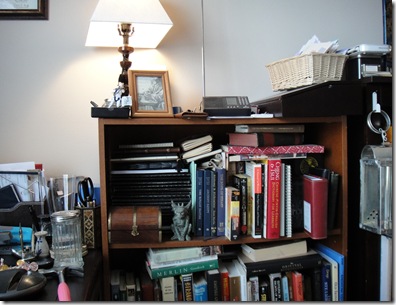
My bookshelves in a state of confusion. See if you can spot: 1. Sandtrooper, 2. Gargoyle, 3. Engraving of Erasmus, 4. External Hard Drive, 5. Tin lantern. 6. Goose quill pens (2)

My bookshelves in a state of confusion. See if you can spot: 1. Sandtrooper, 2. Gargoyle, 3. Engraving of Erasmus, 4. External Hard Drive, 5. Tin lantern. 6. Goose quill pens (2)
Thursday, December 9, 2010
I'm back
I'm back, but not sure what I should do with this blog. I'll continue to post interesting bits from my reading, and perhaps updates on my fiction and nonfiction research projects. Now that I'm done with school, I shall have more time to produce both sorts of posts. I'll also post some reviews and examinations of certain types of objects that I have come to use in my daily life-- this last requires some explaination.
...
I have come to realize that many of the items our culture uses in daily life have substituted convenience for elegance, and disposablity for practicality. Take men's shaving. The Sears Robuck Catalogues of 1905 or so displayed about 20-30 kinds of straight razors, and one or two safety razors, which consist of a handle and guard to which you attach a disposable single- or double-bladed razor. Safety razors really took off during the First World War, when Gillette sold safety razor sets to servicemen who could not keep a straight razor in the trenches. The safety razor was and is an elegant alternative to the highly involved process of straight razor shaving (which requires a sharpening stone, leather strop, and steady hand).
Modern disposable razors (like the Mach 3) have become expensive, premium goods. A month's supply of razors might cost 20-30 dollars. I used these sorts of razors for years before discovering the safety razor. Double-bladed safety razors are an example of an older technology that performs just as well as its successor, but that is cheaper and more elegant. It's one example of a lifestyle that I've come to aspire to-- the incorporation of older techniques and artifacts alongside contemporary or cutting-edge culture. Thus, I use an entire spectrum of writing tools, from Word 2006 to dip nib pens and goose quills. I keep a leather-bound commonplace book, as well as blogs.
At any rate, for content, here's a post from my commonplace book:
The bicentennial of the City of Columbus is approaching in 2012, as is that of the War of 1812. Two centuries ago there was a small village at Franklinton and another at Worthington. It's interesting to visit these two places now, when they have long since been swallowed up by the relentless growth of the city. Franklinton has changed for the worse: known as "the Bottoms" because 20th century dam projects have raised the water level of the Olantangy and Scioto rivers, causing floods in that low lying area, its one of the most dangerous neighborhoods in the city for crime. By contrast, Worthington is still as bourgeois as its New England founders must have intended, and many of its older brick structures recall the industrious town of Col. Kilbourne.
...
I have come to realize that many of the items our culture uses in daily life have substituted convenience for elegance, and disposablity for practicality. Take men's shaving. The Sears Robuck Catalogues of 1905 or so displayed about 20-30 kinds of straight razors, and one or two safety razors, which consist of a handle and guard to which you attach a disposable single- or double-bladed razor. Safety razors really took off during the First World War, when Gillette sold safety razor sets to servicemen who could not keep a straight razor in the trenches. The safety razor was and is an elegant alternative to the highly involved process of straight razor shaving (which requires a sharpening stone, leather strop, and steady hand).
Modern disposable razors (like the Mach 3) have become expensive, premium goods. A month's supply of razors might cost 20-30 dollars. I used these sorts of razors for years before discovering the safety razor. Double-bladed safety razors are an example of an older technology that performs just as well as its successor, but that is cheaper and more elegant. It's one example of a lifestyle that I've come to aspire to-- the incorporation of older techniques and artifacts alongside contemporary or cutting-edge culture. Thus, I use an entire spectrum of writing tools, from Word 2006 to dip nib pens and goose quills. I keep a leather-bound commonplace book, as well as blogs.
At any rate, for content, here's a post from my commonplace book:
Judge Gustavus Swann, in Fitzpatrick and Morris, Franklinton Centennial (1897).When I opened my office in Franklinton in 1811, there was neither church nor school nor pleasure carriage in the country, nor was there a bridge over any stream within the compass of an hundred miles... Goods were imported, principally from Philadelphia in wagons; and our exports, consisting of horses, cattle and hogs, carried themselves to market. The mails were brought to us once a week on horseback, if not prevented by high water.
The bicentennial of the City of Columbus is approaching in 2012, as is that of the War of 1812. Two centuries ago there was a small village at Franklinton and another at Worthington. It's interesting to visit these two places now, when they have long since been swallowed up by the relentless growth of the city. Franklinton has changed for the worse: known as "the Bottoms" because 20th century dam projects have raised the water level of the Olantangy and Scioto rivers, causing floods in that low lying area, its one of the most dangerous neighborhoods in the city for crime. By contrast, Worthington is still as bourgeois as its New England founders must have intended, and many of its older brick structures recall the industrious town of Col. Kilbourne.
Sunday, June 6, 2010
Cell Phone Pics
I use my cell phone camera quite a bit. Oftentimes it works simply as a memo pad, to record something I want to remember for later, like the title of an interesting looking book. Since I rarely bring a camera with me when I go places or travel, when I want to record a moment or an object, out comes my low-resolution camera. The pictures are usually pretty blurry, but at least its some kind of record of the subject.
(fig. a)

(fig. b)
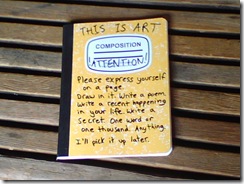
(fig. c)
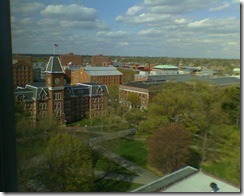
(fig. d)

(fig. e)

(fig. f)

(fig. g)

(fig. h)

(fig. i)

Fig. a: A small songbird found dead next to a cigarette. Smoking kills, kids.
Fig. b: Composition notebook found at the Blackburn House bus stop.
Fig. c: View of University Hall from the upper floors of the Thompson Library, OSU campus.
Fig. d: Geocache found in Westerville.
Fig. e: Graffiti on the GAR Monument at Fort Meigs, Perrysburg Ohio.
Fig. f: Display summarizing the economic geology of Ohio, Mendenhall Labs, OSU campus.
Fig. g: 5.5 inch howitzer, Fort Meigs.
Fig. h: Three officers of French Hussar Regiments, Osprey book.
Fig. i. Pan and lock of 1795 pattern Springfield Arsenal musket, before being cleaned.
(fig. a)

(fig. b)

(fig. c)

(fig. d)

(fig. e)

(fig. f)

(fig. g)

(fig. h)

(fig. i)

Fig. a: A small songbird found dead next to a cigarette. Smoking kills, kids.
Fig. b: Composition notebook found at the Blackburn House bus stop.
Fig. c: View of University Hall from the upper floors of the Thompson Library, OSU campus.
Fig. d: Geocache found in Westerville.
Fig. e: Graffiti on the GAR Monument at Fort Meigs, Perrysburg Ohio.
Fig. f: Display summarizing the economic geology of Ohio, Mendenhall Labs, OSU campus.
Fig. g: 5.5 inch howitzer, Fort Meigs.
Fig. h: Three officers of French Hussar Regiments, Osprey book.
Fig. i. Pan and lock of 1795 pattern Springfield Arsenal musket, before being cleaned.
Wednesday, May 26, 2010
Devil’s Dictionary-- Diary
From the Devil’s Dictionary, by Ambrose Bierce:

DIARY, n. A daily record of that part of one's life, which he can relate to himself without blushing.
Hearst kept a diary wherein were writ All that he had of wisdom and of wit. So the Recording Angel, when Hearst died, Erased all entries of his own and cried: "I'll judge you by your diary." Said Hearst: "Thank you; 'twill show you I am Saint the First" -- Straightway producing, jubilant and proud, That record from a pocket in his shroud. The Angel slowly turned the pages o'er, Each stupid line of which he knew before, Glooming and gleaming as by turns he hit On Shallow sentiment and stolen wit; Then gravely closed the book and gave it back. "My friend, you've wandered from your proper track: You'd never be content this side the tomb -- For big ideas Heaven has little room, And Hell's no latitude for making mirth," He said, and kicked the fellow back to earth.
"The Mad Philosopher"
(It’s true, I keep a diary and consistently omit all the things which I would blush to have others read--- or my mind whitewashes the memory for me. So instead of the stupid or thoughtless or rather, course things we do that pass the small moments of the day, my diary merely records what I think about things when the nib meets the paper: of course its a departure from reality, and an exercise in self-gratification to boot.
But in the end, what should I strive to record in my diary? Certainly not just important things, since life is mainly made up of ordinary, boring moments. Certainly not every mundane thing that comes to mind, since that would be of no interest. Perhaps, what I like to read in journals that have come down to us from the past: interesting things, and the flavor of daily life. Especially the latter, since in time all our world will fade away, and be replaced by new things.)
Subscribe to:
Posts (Atom)